If your business relies on chaotic paper trails, lost email threads, and manual invoice matching, you are already falling behind. Traditional purchasing methods simply cannot keep up with the speed of modern commerce, leaving companies blind to hidden costs and rogue spending. As digital transformation sweeps across the Middle East, a new standard has emerged to eliminate this chaos. This guide will clearly answer “what is e-procurement,” explain exactly how the technology works step-by-step, and show you why it is absolutely essential for building a resilient, modern supply chain.
What is E-Procurement? (The Simple Definition)
At its most basic level, what is e-procurement? E-procurement (electronic procurement) is the business-to-business (B2B) purchase and sale of supplies, work, and services through the internet and specialized software.
Instead of an employee filling out a paper form, handing it to a manager for a physical signature, and mailing it to a supplier, the entire purchasing lifecycle is moved into a centralized, cloud-based platform.
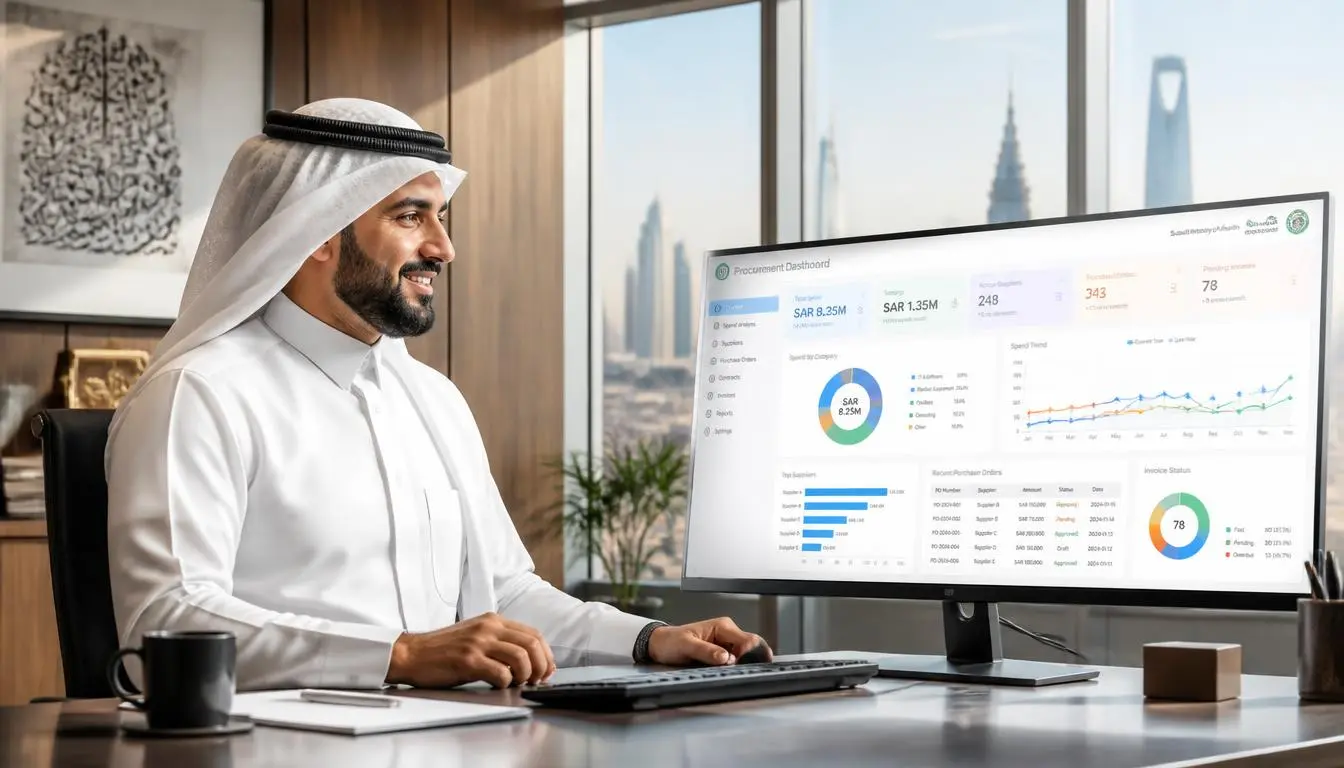
E-procurement acts as a digital bridge connecting buyers and suppliers. It consolidates everything from browsing catalogs and requesting approvals, to generating purchase orders (POs) and paying invoices into a single, highly visible digital dashboard. For businesses looking to scale, adopting an e-procurement platform is the foundation of digital transformation, replacing disconnected spreadsheets with real-time, actionable data.
Traditional Procurement vs. E-Procurement: What’s the Difference?
To truly understand the value of e-procurement, it helps to compare it side-by-side with traditional purchasing methods.
Traditional Procurement:
- Highly Manual: Relies on physical paperwork, emails, phone calls, and manual data entry.
- Error-Prone: High risk of human error during invoice matching and PO generation.
- Slow Approvals: Paper requests sit on desks waiting for physical signatures, delaying critical supplies.
- Decentralized Spend: Different departments buy off-contract from unauthorized vendors, leading to invisible “rogue spend.”
- Poor Visibility: Finance teams must wait until the end of the month to see where the budget went.
E-Procurement:
- Fully Automated: Requisitions, POs, and invoices are generated and matched automatically by the software.
- Highly Accurate: Digital audit trails and automated three-way matching leave virtually no room for manual errors.
- Instant Approvals: Requests are routed instantly to managers via mobile or desktop notifications.
- Centralized Control: Employees shop from pre-approved digital catalogs, ensuring they only buy from vetted vendors at negotiated rates.
- Real-Time Visibility: The CFO has a live, real-time dashboard of all company spending the moment an order is placed.
The Key Components of an E-Procurement System
E-procurement is often used as an umbrella term. A complete, enterprise-grade e-procurement ecosystem is actually made up of several interconnected modules. Here are the key components:
E-Sourcing
This is the process of finding, evaluating, and engaging new suppliers digitally. Instead of attending trade shows or making cold calls, businesses use digital portals to vet potential vendors, check their compliance, and invite them to bid on contracts.
E-Tendering
When a company needs to make a large purchase, they send out a Request for Information (RFI) or a Request for Proposal (RFP). E-tendering moves this process online. Suppliers submit their bids securely through the platform, allowing the buyer to compare pricing and terms side-by-side in a standardized format.
E-Purchasing (E-Ordering)
This is the day-to-day B2B marketplace experience. It works much like consumer online shopping. Employees log into a platform like Supplies Hub, browse a curated catalog of approved office supplies or raw materials, add items to a digital cart, and submit the order for approval.
E-Invoicing
E-invoicing replaces physical mail and PDFs. When a vendor ships an item, they submit a digital invoice directly into the e-procurement system. The software automatically matches the invoice against the original PO and the delivery receipt, preparing it for immediate payment.
How Does E-Procurement Work? A Step-by-Step Guide
To understand how e-procurement transforms a supply chain, let’s walk through the actual user journey of buying a simple batch of office laptops.
- Step 1: The Requisition: An IT manager realizes the department needs five new laptops. They log into their company’s e-procurement portal, search the centralized catalog, find the pre-approved laptop model, and add five to their cart. They click “Submit.”
- Step 2: Automated Approval: The software recognizes that the total cost is 20,000 SAR. Based on the company’s internal rules, it automatically routes the request to the IT Director for approval. The Director receives a notification on their phone and clicks “Approve.”
- Step 3: PO Generation: The moment the request is approved, the software instantly generates a digital Purchase Order (PO) and sends it directly to the contracted electronics vendor.
- Step 4: Delivery & Three-Way Matching: The vendor delivers the laptops and uploads an e-invoice. The e-procurement system performs a “three-way match” it automatically checks that the invoice matches the original PO, and that the warehouse has logged the digital delivery receipt.
- Step 5: Payment & Analytics: Because the match is perfect, the invoice is flagged for immediate payment by the finance team. Simultaneously, the 20,000 SAR spend is logged in the CFO’s analytics dashboard, updating the IT budget in real-time.
The Major Benefits of E-Procurement Software
Why are thousands of businesses across the globe abandoning paper for digital platforms? The benefits of e-procurement ripple across every department in a company.
1. Cost Control & Complete Spend Visibility
The greatest advantage of e-procurement is the elimination of rogue spend. Because employees can only purchase from pre-approved catalogs, you never have to worry about staff buying overpriced items from unvetted vendors. Furthermore, the CFO gains 100% visibility into corporate spending, allowing for better budget forecasting and strategic cost-cutting.
2. Massive Time Savings
By automating the Procure-to-Pay (P2P) cycle, e-procurement gives your team their time back. Managers no longer spend hours hunting down physical signatures, and accounts payable teams no longer waste days manually entering invoice data. Orders that used to take weeks to process can now be completed in minutes.
3. Reduced Errors & Fraud Prevention
Manual data entry is prone to typos, misplaced decimal points, and lost documents. E-procurement creates an unbreakable digital audit trail. Every action who requested an item, who approved it, and who paid for it is time-stamped. This virtually eliminates accidental overpayments and drastically reduces the risk of internal fraud.
4. Better Supplier Relationships
Suppliers love e-procurement just as much as buyers do. Because invoices are submitted digitally and matched automatically, vendors get paid much faster. Clear, digital communication reduces disputes over lost orders or incorrect pricing, fostering stronger, more collaborative partnerships.
5. Alignment with KSA Digital Readiness
For businesses operating in Saudi Arabia, digital transformation is no longer optional. With the Zakat, Tax and Customs Authority (ZATCA) rolling out strict e-invoicing mandates, adopting an e-procurement system ensures immediate regulatory compliance. Furthermore, it directly aligns your business with the paperless, modernized vision of Saudi Vision 2030.
How to Get Started with E-Procurement in Your Business
Transitioning to e-procurement does not require a massive, multi-year IT overhaul. You can begin the process with a few simple, actionable steps:
- Audit Your Current Process: Map out exactly how your business currently buys goods. Identify where the bottlenecks are is it in the approval phase, or the invoice matching phase?
- Calculate Your Rogue Spend: Look at your credit card statements and expense reports to see how much money is being spent outside of your negotiated vendor contracts.
- Choose a Cloud-Based Partner: Look for modern B2B platforms that offer “plug-and-play” simplicity rather than complex legacy software installations.
Conclusion
So, what is e-procurement? It is the ultimate tool for bringing transparency, speed, and massive cost savings to your B2B purchasing operations. By moving your supply chain to a centralized digital platform, you empower your employees to buy what they need quickly, while giving your finance team the control they require to protect the bottom line.
If you are ready to modernize your purchasing processes and say goodbye to manual paperwork, explore the Supplies Hub B2B marketplace today to see how easy the transition to digital procurement can be.