
No products in the cart.

Every growing business hits a predictable operational bottleneck. As headcounts expand and branch offices multiply, purchasing essential indirect goods from office machines, networking hardware, and ergonomic furniture to


Quick Summary:
B2B procurement outsourcing is the fastest way to scale operations in Saudi Arabia while simultaneously reducing overhead. This comprehensive guide explains how shifting your supply chain management to local experts ensures ZATCA compliance, boosts your Local Content scores, and dramatically cuts operational costs.
The Saudi Arabian economy is expanding at an unprecedented rate under Vision 2030, bringing massive opportunities alongside complex supply chain challenges. For growing businesses, managing an in-house purchasing department can quickly become a costly bottleneck that distracts from core strategic operations. Navigating the nuances of local supplier networks, strict tax compliance, and modern digital procurement demands a highly specialized skill set. That is precisely where procurement outsourcing services step in to bridge the gap. By handing over the purchasing reins to dedicated professionals, companies can instantly convert fixed overheads into variable, manageable costs. In this guide, we break down exactly how leveraging an outsourced model can transform your bottom line in the Kingdom.
Before diving into the strategic advantages, it is important to clarify exactly what we mean when we discuss outsourcing in the B2B context. The difference between standard purchasing and procurement dictates the level of service you need.
Procurement Outsourcing is the transfer of specific supply chain processes—or an entire procurement department—to an external, specialized third-party provider. This is not simply about hiring someone to place orders; it is about delegating strategic sourcing, vendor management, contract negotiation, and digital compliance to experts.
The service typically falls into two main categories:
The decision to outsource is almost always driven by the desire to reduce office operational costs. However, in the unique regulatory and economic environment of Saudi Arabia, the benefits extend far beyond simple cost-cutting.
Building an in-house procurement team requires a significant investment in salaries, training, software licenses, and office space. By outsourcing, you convert these massive fixed costs into scalable, variable costs. You only pay for the procurement resources and expertise you actually use, which is incredibly beneficial for companies whose purchasing needs fluctuate based on project timelines or seasonality.
Compliance in the KSA is no longer optional, and it is entirely digitized. The Zakat, Tax and Customs Authority (ZATCA) requires all B2B transactions to comply with strict e-invoicing (Fatoora) standards. Setting up an internal ERP system to handle this can take months and cost hundreds of thousands of Riyals. A professional procurement outsourcing service already has these compliant digital architectures in place. They assume the burden of regulatory compliance, ensuring that every invoice processed is perfectly aligned with Saudi tax laws, saving you from severe financial penalties.
Many internal procurement teams get bogged down in the day-to-day tactical work: chasing approvals, answering emails, and fixing mismatched invoices. This leaves zero time for high-value activities. By outsourcing the transactional heavy lifting, your business instantly upgrades to a strategic procurement model.
“Outsourcing procurement isn’t just about cutting headcount; it’s about plugging your business directly into a pre-vetted, compliant, and localized supply chain from day one.” — Supply Chain Expert
An outsourcing provider does not just bring software; they bring a massive, established network of reliable vendors. Because they procure goods on behalf of multiple clients, they have significant purchasing power. They can leverage this volume to secure bulk discounts, better Service Level Agreements (SLAs), and faster delivery times that a single, independent company could never negotiate on its own.

Transitioning from in-house to outsourced procurement is a major operational shift. Knowing when to make this leap is critical for maximizing ROI. If your business is experiencing any of the following scenarios, it is time to consider an outsourced partner.
If your company has won a contract to operate in major new developments like Neom, Qiddiya, or the Red Sea Project, you will immediately need localized logistics and supply chain support. Building an on-the-ground procurement team in these newly developing areas from scratch is incredibly slow and expensive. An outsourcing partner with a nationwide logistical footprint allows you to scale instantly.
Maverick spend occurs when employees purchase goods or services outside of the approved vendor list or without proper authorization. In rapidly growing startups or decentralized corporations, maverick spend can account for up to 30% of total procurement costs. If your finance team is constantly fighting unapproved expenses or struggling to track where the budget is going, an outsourcing partner will implement strict digital controls to eliminate this leakage overnight.
Foreign companies entering the KSA market often struggle with the cultural and regulatory nuances of Saudi business. They may not know which local vendors are reliable, what the standard market rates are, or how to navigate customs clearance at Saudi ports. Engaging an outsourcing firm bridges this knowledge gap instantly, providing immediate access to local market intelligence that would otherwise take years to acquire.
A common misconception is that outsourcing means losing control over your purchasing decisions. In reality, a modern outsourcing partnership provides more visibility and control through structured, data-driven workflows. Here is the step-by-step procurement process of how an outsourced partner takes over and optimizes your supply chain.
Before any purchasing happens, the outsourcing partner conducts a comprehensive audit of your historical spend data. They analyze your past purchase orders, vendor contracts, and invoices to identify inefficiencies. This audit reveals where you are overpaying, which supplier contracts are underperforming, and where there are opportunities for immediate cost consolidation.
Control is maintained through strict Service Level Agreements (SLAs). The partner will work with your executive team to define exactly what success looks like. This involves setting up specific procurement KPIs such as:
By defining these metrics upfront, you guarantee that the outsourcing firm remains fully accountable for driving continuous improvement.
Based on the spend audit, the outsourcing partner will begin consolidating your vendor base. Instead of managing 50 different suppliers for indirect materials (like office supplies, IT equipment, and facilities maintenance), the partner might consolidate this down to 5 highly strategic relationships. They will aggressively vet these remaining suppliers for quality, financial stability, and ZATCA compliance, ensuring a frictionless supply chain.
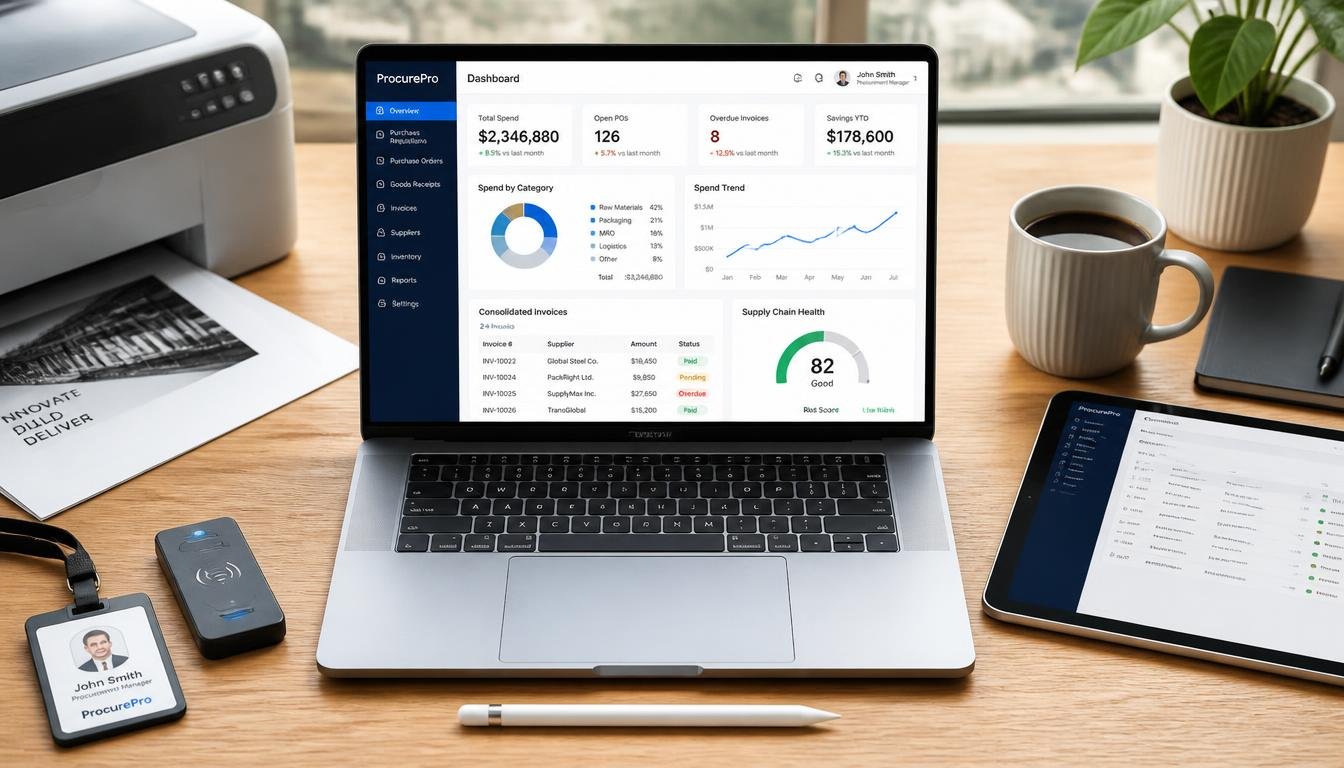
The final operational step is technology integration. The outsourcing partner will typically deploy a centralized e-procurement platform (or integrate with your existing ERP). This digital environment automates the Procure-to-Pay (P2P) cycle. When your employees need supplies, they log into a customized portal (similar to a consumer e-commerce site) to request items from the pre-approved catalog. The software automatically routes the request for management approval, generates the PO, and matches the final invoice all without manual human intervention.
If there is one unique factor that separates the Saudi Arabian procurement landscape from the rest of the world, it is the emphasis on Local Content.
Under Vision 2030, the Local Content and Government Procurement Authority (LCGPA) has mandated that government entities and the private companies that contract with them must prioritize domestic spending. A company’s “Local Content Score” is calculated based on how much they spend on Saudi-made goods, Saudi services, and the employment of Saudi nationals.
For many companies, especially international firms, identifying, vetting, and onboarding qualified local SMEs to boost this score is a monumental challenge. It requires a deep understanding of the local industrial landscape.
This is where procurement trends in KSA are heavily favoring outsourcing. A specialized Saudi procurement partner inherently possesses a massive database of verified, high-quality local suppliers. By channeling your purchasing through these partners, your company instantly injects local spending into your supply chain. This organically boosts your Local Content score, making your business vastly more competitive when bidding for lucrative government contracts, tenders from entities like NUPCO, or mega-projects aligned with Vision 2030.
Managing a modern supply chain in Saudi Arabia requires agility, digital compliance, and deep local expertise. As the market matures, attempting to handle all procurement functions in-house is rapidly becoming a competitive disadvantage.
Procurement outsourcing services offer a strategic shortcut. By partnering with experts, you not only eliminate the headaches of ZATCA compliance and maverick spend but also unlock massive cost savings through vendor consolidation and P2P automation. More importantly, it frees up your executive team to focus on what actually matters: growing your core business and capitalizing on the extraordinary opportunities presented by Vision 2030.
Next Steps: Are you ready to convert your procurement department from a cost center into a strategic asset? Assess your current purchasing workflows, evaluate your Local Content goals, and consider consulting with a specialized KSA procurement partner today to unlock your supply chain’s true potential.

Every growing business hits a predictable operational bottleneck. As headcounts expand and branch offices multiply, purchasing essential indirect goods from office machines, networking hardware, and ergonomic furniture to
Every growing organization eventually hits a purchasing crossroad: should you recruit an internal buying department or partner with an external sourcing provider? As supply chains face rapid economic

Summary Outsourcing procurement allows businesses to reduce indirect purchasing costs by 15% to 22%, eliminate maverick spending, and reclaim up to 14 staff hours per department each week.