
No products in the cart.

Every growing business hits a predictable operational bottleneck. As headcounts expand and branch offices multiply, purchasing essential indirect goods from office machines, networking hardware, and ergonomic furniture to


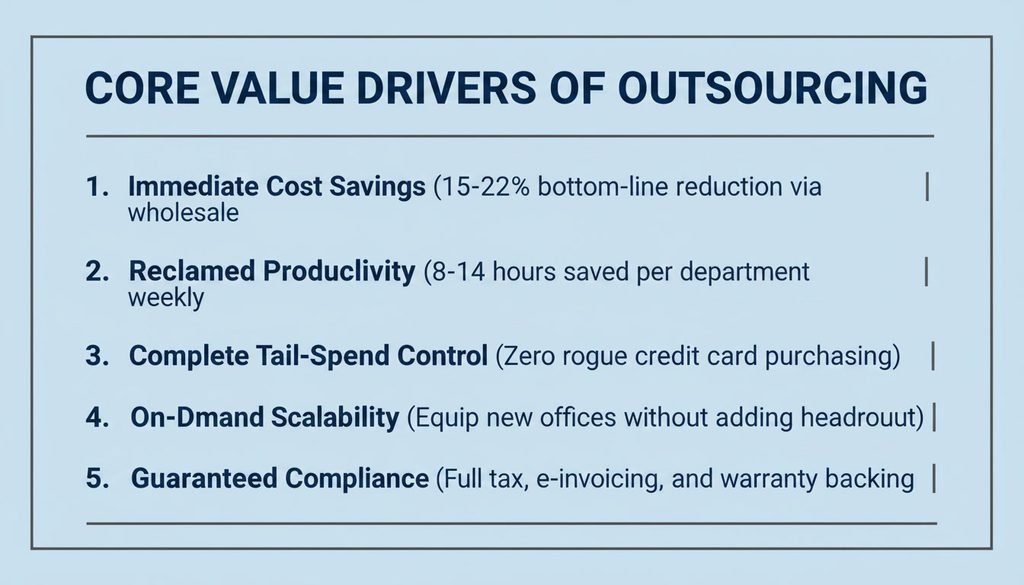
Outsourcing procurement allows businesses to reduce indirect purchasing costs by 15% to 22%, eliminate maverick spending, and reclaim up to 14 staff hours per department each week. Rather than replacing internal leadership, modern procurement outsourcing operates as a hybrid model: organizations retain control over core strategic goods while routing high-volume indirect items, office equipment, and tail spend through specialized digital procurement platforms like Supplies Hub.
Traditional in-house purchasing models create severe operational bottlenecks because internal teams spend 80% of their working hours managing low-value, transactional purchases. When finance teams, administrative staff, or department managers handle everyday sourcing manually, organizations suffer from high unit costs, administrative drag, and unmonitored budget leakage.
Managing modern corporate purchasing requires continuous vendor negotiations, catalog comparisons, compliance audits, and invoice reconciliations. For most growing companies, building an internal department dedicated to non-strategic supplies creates three distinct operational breakdowns:
The benefits of outsourcing procurement center on immediate cost reduction, captured staff hours, bulk purchasing leverage, and hardened supply chain compliance. By partnering with an external procurement partner or centralized digital B2B platform, organizations replace hundreds of disparate purchasing points with a unified, transparent procurement channel.
Outsourcing partners pool supply demand across hundreds of corporate clients, securing volume discount tiers that individual companies cannot access alone.
When an independent business negotiates with an equipment manufacturer for three office printers or ten cases of paper, it receives standard commercial retail rates. A specialized procurement provider purchases tens of thousands of units across its network, passing tier-one distributor pricing directly to client accounts. Industry benchmarks from the Chartered Institute of Procurement & Supply (CIPS) show that companies moving from transactional purchasing to outsourced agreements see average cost reductions between 15% and 22% within their first year.
Outsourcing tactical purchasing eliminates administrative paperwork, returning an average of 8 to 14 productive hours per week to finance, operations, and administrative personnel.
In companies without outsourced procurement, office managers spend hours sourcing vendor bids, operations directors chase down delayed shipments, and finance managers manually match purchase orders against disparate invoices. Outsourcing transfers catalog management, vendor vetting, and logistics tracking to an external infrastructure, allowing internal teams to focus strictly on strategic growth initiatives.
A specialized procurement partner cuts purchase order fulfillment cycles by up to 55% by utilizing established distributor channels and standardized product catalogs.
Instead of issuing lengthy Requests for Proposals (RFPs) for standard business gear, team members select approved items from a pre-negotiated marketplace. Orders are dispatched through established fulfillment networks, eliminating supply delays that halt office expansions or disrupt daily business operations.
Consolidated procurement platforms convert untracked receipts and petty-cash spending into clean, categorized digital expenditure data.
Finance leaders receive unified monthly reporting showing exact spend patterns across every business unit, department, and location. This granular visibility highlights consumption patterns, eliminates redundant orders, and ensures complete budgetary adherence across the entire organization.
Outsourced procurement allows businesses to support new branch offices, onboarding surges, and regional expansions without hiring additional purchasing coordinators.
When a company scales from 50 to 300 employees, internal administrative departments usually buckle under the increased procurement volume. An external procurement partner absorbs this volume instantly through automated digital portals, providing identical fulfillment speeds and discounted pricing regardless of company growth velocity.
Small and medium enterprises outsource procurement to gain immediate purchasing leverage and avoid hiring dedicated staff, while large enterprises outsource to eliminate tail-spend complexity, enforce compliance, and streamline vendor management.
Because both business tiers operate under completely different financial constraints, the strategic return on investment takes two distinct forms:
| Evaluation Factor | Impact on SMEs (Small & Mid-Sized) | Impact on Large Enterprises |
| Primary Business Objective | Gaining tier-one corporate pricing without headcount. | Consolidating micro-vendors and eliminating rogue spending. |
| Purchasing Pain Point | Paying retail markups due to low order volumes. | High administrative costs processing thousands of low-value POs. |
| Resource Allocation | No dedicated procurement staff; founders or office managers buy. | CPO teams are overwhelmed by low-value indirect supply requests. |
| Direct Financial Impact | Immediate 15% to 20% margin improvement on operational supplies. | Millions saved in accounts payable processing and invoice audits. |
| Deployment Speed | Instant access through self-serve business accounts like Supplies Hub. | API/ERP-integrated catalog rollouts across multiple departments. |
Small businesses rarely have the purchasing volume to negotiate directly with major hardware manufacturers or authorized importers. Consequently, they purchase office technology, paper supplies, and furniture through consumer retail channels at premium prices.
Outsourcing through a digital business platform gives an SME instant access to institutional price structures, credit payment terms, and dedicated customer support. This levels the playing field, allowing smaller firms to access identical supply economics enjoyed by multinational corporations.
For an enterprise with multiple office locations, managing routine supplies internally generates immense organizational drag. A company with 1,000 employees might work with over 70 separate vendors for stationary, printing equipment, facility cleaning goods, and ergonomic desks.
Processing an individual purchase order internally costs large organizations an average of
60to
60to120 in administrative labor. By routing all indirect requirements through a single outsourced procurement partner, the enterprise reduces 70 vendor relationships down to one, drastically slashing invoicing overhead and mitigating supply chain risks.
A business should transition to outsourced procurement when transactional purchasing begins consuming strategic management time, internal invoice processing costs exceed acceptable thresholds, or rogue spending creates chronic budget variances.
If your leadership team experiences two or more of the following operational symptoms, keeping procurement entirely in-house is actively draining company capital:
ACCOUNTS PAYABLE OVERLOAD:
DISPERSED MAVERICK SPENDING:
EXPANSION BOTTLENECK:
ZERO SPEND VISIBILITY:
TALENT MISALLOCATION:
Recognizing these triggers early prevents organizations from falling into the overhead trap, where companies prematurely hire costly in-house purchasing coordinators who spend their days processing low-leverage paperwork.
You maintain complete operational control by adopting a Hybrid Procurement Model, keeping critical strategic materials in-house while delegating non-core, indirect supplies to a vetted digital procurement partner.
The greatest misconception among finance executives is that outsourcing requires surrendering authority over spending decisions. Modern digital procurement outsourcing does not hand blank checks to third parties; instead, it uses technological guardrails that enforce stricter governance than manual internal systems.
INTERNAL LEADERSHIP (Kept In-House)
OUTSOURCED PARTNER (e.g., Supplies Hub)
Digital procurement platforms allow leadership to set role-based access rules. Department heads can select the items they need from pre-approved catalogs, but orders above a specified threshold (such as 1,000 SAR or $500) automatically route to the finance director’s dashboard for digital sign-off before fulfillment.
Outsourcing partners configure customized digital storefronts displaying only corporate-approved brands and items. This eliminates rogue spending by ensuring staff cannot select overpriced, incompatible, or non-compliant equipment.
Instead of receiving 50 disparate bills throughout the month, the hybrid framework delivers one consolidated, itemized monthly statement. Finance teams review a single digital ledger, reconciling an entire month of cross-department supplies in minutes.
Digital procurement platforms like Supplies Hub provide the modern infrastructure for this hybrid model. By offering an extensive catalog of business machines, plotters, high-capacity printers, toner, and office essentials, Supplies Hub acts as an on-demand corporate purchasing arm. Businesses gain the pricing advantages and fulfillment speed of an enterprise supplier network without signing complex multi-year consulting retainers.
International businesses operating in Saudi Arabia and the wider GCC region must navigate stringent regulatory requirements, making local market knowledge essential for operational continuity and financial compliance.
Outsourcing to generic offshore services creates severe friction with regional regulatory bodies and local supply chains. Working with a dedicated regional partner resolves three critical regional requirements:
In Saudi Arabia, all business transactions must comply with the Zakat, Tax and Customs Authority (ZATCA) Phase 2 (FATOORA) electronic invoicing regulations. Unvetted micro-suppliers frequently issue non-compliant receipts, exposing client organizations to severe financial penalties and VAT audit rejections. A professional regional procurement partner guarantees that every invoice is cryptographically signed, compliant with QR codes, and directly integrated into the national tax architecture.
Procurement efficiency collapses if delivery timelines are unpredictable. A localized procurement network maintains established warehousing and distribution channels across major industrial centers including Riyadh, Jeddah, and the Eastern Province. This local presence eliminates customs holdups, costly import fees, and multi-week shipping delays typical of international suppliers.
Under Saudi Vision 2030, government and major enterprise tenders prioritize organizations that demonstrate high local content scores through the Local Content and Government Procurement Authority (LCGPA). Partnering with registered, locally based supply networks ensures your company’s indirect spending actively supports national economic frameworks.
While the benefits are significant, poorly executed procurement outsourcing can lead to vendor lock-in, employee resistance, or degraded service quality. Organizations must actively manage three specific operational pitfalls:
No. Outsourcing indirect procurement removes low-value administrative work from your internal team. Instead of managing purchase orders for stationery, toner, and office hardware, internal procurement managers can dedicate their time to high-stakes strategic negotiations, core product materials, and major vendor relationships.
Direct procurement involves the raw materials, components, and goods directly used to manufacture your end products. Indirect procurement involves everything required to run the day-to-day business, including office technology, software, maintenance supplies, and workplace consumables. Indirect procurement is the easiest and most profitable category to outsource.
Most organizations achieve a direct purchase savings of 15% to 22% by accessing aggregate volume pricing. Additionally, companies reduce internal purchase-order processing costs by 30% to 50% through vendor consolidation and automated invoicing.
Yes. Modern digital procurement marketplaces like Supplies Hub provide corporate catalog pricing, streamlined ordering, and centralized billing without requiring costly consulting contracts or complex enterprise software installations.
Outsourcing procurement transforms business purchasing from a slow, expensive administrative burden into a competitive advantage. By delegating high-volume indirect supplies, office tech, and tail spend to specialized external channels, organizations capture immediate wholesale savings, eliminate rogue expenses, and free their staff to concentrate on core business growth.
Whether you are an ambitious SME seeking institutional buying power or an established enterprise working to streamline operations across multiple branches, the modern hybrid model offers complete spend visibility, hardened tax compliance, and effortless scalability.
Explore how Supplies Hub streamlines your business purchasing. Access curated commercial equipment, high-performance office tech, and everyday essentials through a unified digital procurement channel tailored for modern operational efficiency.

Every growing business hits a predictable operational bottleneck. As headcounts expand and branch offices multiply, purchasing essential indirect goods from office machines, networking hardware, and ergonomic furniture to
Every growing organization eventually hits a purchasing crossroad: should you recruit an internal buying department or partner with an external sourcing provider? As supply chains face rapid economic
Summary Outsourcing procurement allows businesses to reduce indirect purchasing costs by 15% to 22%, eliminate maverick spending, and reclaim up to 14 staff hours per department each week.