No products in the cart.


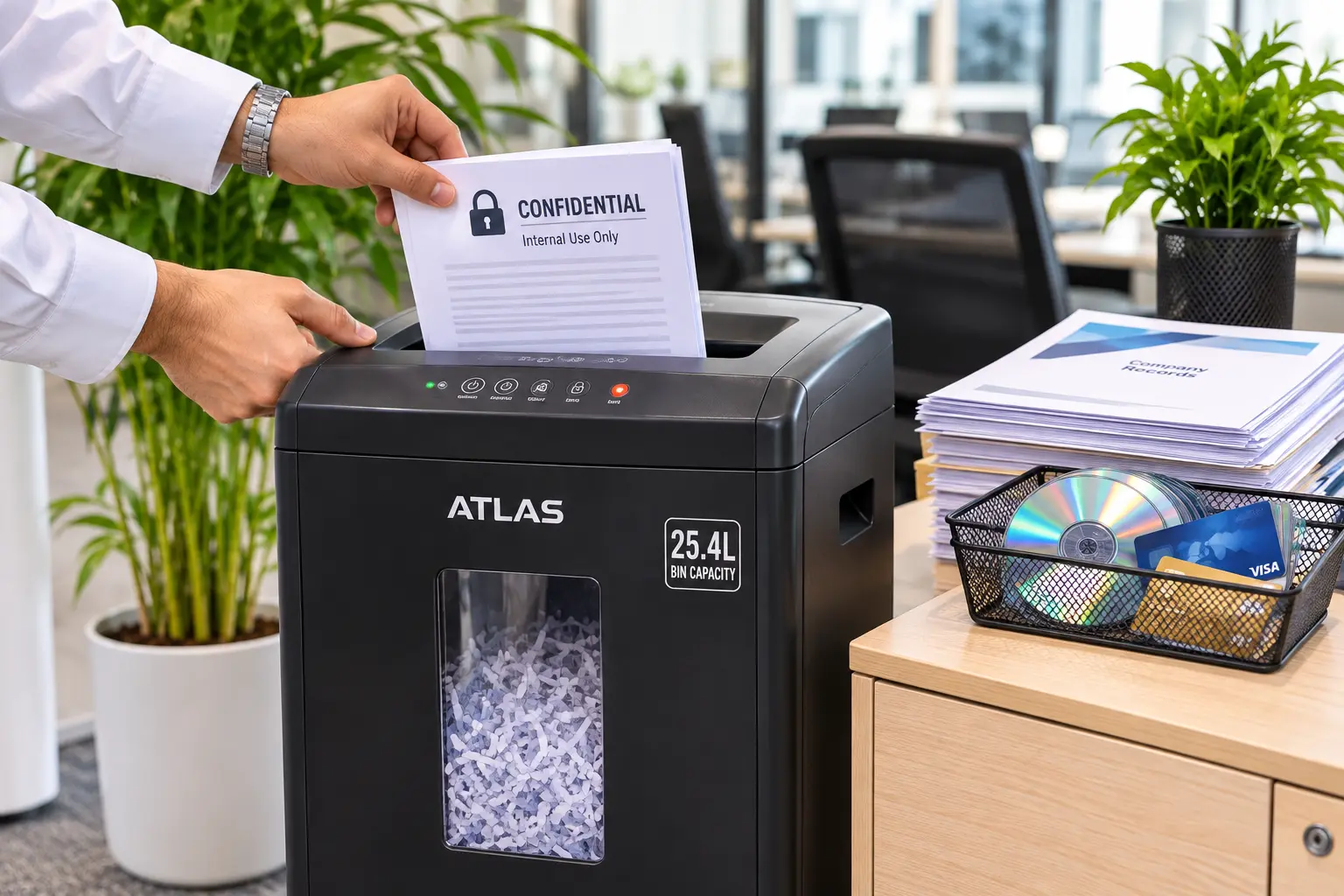
Quick Summary: Learning how to choose a paper shredder for a Saudi office depends on four measurable specifications: DIN 66399 security level, sheet pass capacity, motor duty cycle,

No products in the cart.
Executive Summary:
Running out of workplace consumables creates operational bottlenecks, triggers employee hoarding, and drives expensive retail runs. This operational guide details the exact mathematical formulas for Reorder Points (ROP) and Safety Stock, breaks down an office-tested ABC classification matrix, and illustrates how to deploy a visual Two-Bin Kanban system to eliminate stockouts without complicated tracking software.
Every office administrator knows the panic of discovering an empty paper tray minutes before an executive presentation, or finding that the last black toner cartridge was installed three days ago without anyone logging the replacement. When workplace replenishment relies on mental notes, sticky pads, and emergency retail trips, budgets bleed through uncontrolled petty cash claims. Managing your office supplies inventory does not require barcoding every single ballpoint pen; it requires a reliable, math-backed replenishment rhythm that keeps your workplace operating without friction.
Office supplies rarely receive the formal inventory scrutiny given to warehouse merchandise or direct project materials. Because individual items like sticky notes, file folders, and marker packs seem inexpensive, supply management is often relegated to an administrative afterthought. In fast-moving corporate workspaces, this lack of structure triggers a cascading failure:
| Stage in the Failure Chain | Operational Symptom | Business & Financial Impact |
| 1. Unmonitored Closet | No designated thresholds or tracking | Inconsistent supply visibility |
| 2. Sudden Stockouts | Printer paper or toner unexpectedly hits zero | Urgent work and executive meetings stall |
| 3. Employee Reaction | Staff panic and hide boxes in personal desks | +30% “Phantom Demand” through hoarding |
| 4. Emergency Purchasing | Staff run to local retail stores with petty cash | +25% to 40% price markup over B2B rates |
| 5. Administrative Waste | Finance reconciles dozens of loose paper receipts | 225 to 375 SAR administrative cost per PO |
When an office runs out of critical items, someone is sent to a nearby retail bookstore with a corporate credit card or petty cash. Retail stationers charge between 25% and 40% more than contracted business-to-business rates. Furthermore, these transactions generate loose receipts that take hours for accounting teams to manually reconcile at the end of each billing cycle.
When team members experience two or three sudden stockouts of printer paper or black ink, their behavior shifts. Department assistants begin hoarding supplies in their personal desk drawers “just in case.” This artificial hoarding inflates baseline consumption by up to 30%, distorting real historical data and causing procurement officers to over-order items that subsequently sit unused for months.
Data from the Chartered Institute of Procurement & Supply (CIPS) reveals that the total administrative cost of raising, verifying, and paying a single manual purchase order typically ranges from $60 to $100 (225 to 375 SAR). When an office places eight small, disjointed orders every month for paper, ink, coffee pods, and cleaning supplies, the administrative labor spent managing purchase orders often exceeds the wholesale value of the supplies themselves.
A stockout of office consumables is rarely just an inconvenience; it represents an immediate stop-work condition that ripples across entire departments:
The biggest mistake administrators make is attempting to manage every item with identical scrutiny. Spending forty-five minutes tracking ten loose ballpoint pens is an inefficient use of company time, but failing to monitor a set of high-yield toner cartridges can halt your entire accounting team.
The solution is the Office ABC Classification Matrix, which sorts your inventory by expenditure and operational criticality:
| Classification | Portfolio Share | Spend Share | Representative Items | Management Strategy | Storage & Access |
| Class A (High Value / Critical) | ~10% of SKUs | ~70% of spend | OEM toner cartridges, drum units, premium presentation paper, docking hubs, specialty badges. | Strict quantitative controls, calculated reorder points, bi-weekly audits. | Locked supply cabinet; designated admin sign-out. |
| Class B (Moderate Velocity / Standard Value) | ~20% of SKUs | ~20% of spend | Standard A4 copy paper (80gsm), thermal receipt rolls, heavy-duty staplers, breakroom coffee pods. | Monthly automated par reviews, standardized batch ordering. | Centralized supply room, open-shelf layout. |
| Class C (Low Value / High Consumption) | ~70% of SKUs | ~10% of spend | Ballpoint pens, paperclips, sticky notes, standard tape, envelopes, paper cups. | Visual replenishment (Two-Bin Kanban), bulk bi-monthly ordering. | Open departmental stations; zero individual tracking. |
By focusing rigorous quantitative tracking solely on Class A and select Class B items, administrative teams reduce weekly inventory tracking time by over 60% while retaining complete oversight over 90% of their consumable budget.
A Reorder Point (ROP) is the exact inventory threshold that triggers a purchase order. Ordering before this point wastes storage space and working capital; ordering after this point guarantees a stockout.
Reorder Point (ROP) = (Average Daily Usage × Lead Time) + Safety Stock
Safety Stock = (Maximum Daily Usage × Maximum Lead Time) − (Average Daily Usage × Average Lead Time)
Let us calculate the reorder point for an active 120-person regional office sourcing bulk office copy paper and stationery supplies:
Safety Stock = (4×6) − (2×3) = 24 − 6 = 18 boxes
Lead Time Demand = 2 boxes/day × 3 days = 6 boxes
ROP = 6 + 18 = 24 boxes
| Inventory Level | Threshold Meaning | Required Operational Action |
| 35+ Boxes | Full Stock / Surplus | No action required. Active stock in circulation. |
| 24 Boxes | Reorder Point (ROP) Trigger | Immediate Action: Place purchase order for standard replenishment batch. |
| 18 Boxes | Safety Stock Buffer Line | Lead time buffer in use. Standard delivery will arrive before this reaches zero. |
| 0 Boxes | Stockout / Emergency Line | Completely avoided when orders are triggered at the 24-box threshold. |
Operational Rule: The moment the storage room inventory dips to 24 boxes, the admin automatically issues a purchase order for the standard batch replenishment quantity. Even if delivery encounters unexpected delays, the 18 boxes of safety stock protect operations from disruption.
You do not need an enterprise software suite to manage daily office consumables. In physical workspaces, software often fails because staff members take a box of pens or a ream of paper without opening an app to record it. Instead, physical visual management guarantees compliance.
| Element | Bin 1 (Active Stock) | Bin 2 (Reserve Stock) |
| Purpose | Unrestricted daily team consumption | Buffer stock protected for lead time |
| Quantity Stored | Standard working batch | Exactly the calculated Reorder Point (ROP) |
| Operational Trigger | When Bin 1 becomes empty… | …flip the Red Reorder Card to trigger purchasing |
| Next Step | Restocked when new delivery arrives | Opened and used while order is in transit |
Organize your physical supply room into three distinct accessibility zones:
Eye-Level Zone (Golden Zone): Class B high-velocity daily supplies (reams of paper, pens, post-its, tape).
Floor & Lower Shelves: Heavy boxed bulk goods to prevent back injuries and shelf bowing.
Top & Lockable Shelves: Expensive Class A assets (office printers, plotters, and replacement toners), accessible only by authorized administrative personnel.
Excel sheets and paper checklists are fine for small offices of ten people, but as an organization scales across departments and regional branches, spreadsheets become single points of failure.
Review this operational diagnostic checklist. If you identify with two or more symptoms, manual tracking is costing your company money:
Operational Insight:
“The primary goal of supply management is not to turn administrators into warehouse stockers; it is to establish predictable systems where consumable replenishment happens invisibly in the background.” — Head of Procurement Strategy, Supplies Hub
Managing fragmented vendors across multiple regions introduces pricing variances, missed delivery windows, and inconsistent billing formats. By consolidating your workplace procurement through an integrated B2B corporate supplies provider, enterprise operations unlock three core structural advantages:
| Procurement Factor | Fragmented Vendor Approach | Consolidated B2B Model |
| Pricing Structure | Retail markup; varies by branch location | Negotiated volume contract pricing across all branches |
| Invoicing & Tax | Disorganized paper receipts; reconciliation errors | 100% ZATCA Phase-2 compliant monthly electronic invoicing |
| Delivery Dependability | Multiple delivery dates; unpredictable lead times | Guaranteed delivery SLAs across Riyadh, Jeddah, and Dammam |
| Toner & Hardware | Bought as ad-hoc, expensive emergency items | Automated auto-replenishment via Managed Print Services (MPS) |
A single multi-branch enterprise contract with distribution centers across Riyadh (Malaz), Jeddah (Sharafiyah), and Dammam (Al Adamah) standardizes replenishment delivery schedules. Centralized operations directors gain uniform lead times regardless of branch location, eliminating regional delivery discrepancies.
In the Kingdom of Saudi Arabia, compliance with the Zakat, Tax and Customs Authority (ZATCA) electronic invoicing framework is legally mandatory. Fragmented cash purchases from local retail stationers frequently result in non-compliant paper slips that complicate input tax deductions. Consolidated B2B procurement delivers fully validated, cryptographically secured tax invoices directly to your accounting department.
Toner cartridges represent the single largest ongoing office supply expense. Rather than purchasing costly cartridges in advance and risking shelf-life degradation, enterprises can implement Managed Print Services (MPS) and automated equipment rentals. Under this model, copiers and printers automatically report consumable levels; replacement toners are dispatched directly to your office when capacity drops below 15%, shifting toner management to a seamless, automated service.
Transforming a chaotic supply room into a reliable, self-regulating inventory hub requires five methodical execution steps:
| Step # | Action Phase | Operational Objective |
| Step 1 | The Audit & Purge | Clear out dried markers, curled paper, and obsolete toner models; count real on-hand stock. |
| Step 2 | ABC Mapping | Classify the top 30 consumables into Class A (high spend), B (paper/pantry), and C (stationery). |
| Step 3 | Calculate ROP & Buffers | Apply the ROP and Safety Stock formulas to all Class A and Class B consumables. |
| Step 4 | Deploy Two-Bin Kanban | Set up physical active/reserve bins with visible red reorder trigger cards. |
| Step 5 | Consolidate Suppliers | Transition to an integrated B2B vendor to automate replenishment and simplify invoicing. |
Tired of unexpected stockouts, messy supply rooms, and stacks of scattered petty cash receipts? Streamline your corporate procurement with Supplies Hub.
From bulk copy paper and ergonomic desk supplies to enterprise IT equipment and Managed Print Services, Supplies Hub supports modern workplaces across Saudi Arabia with competitive contract pricing, fast regional delivery in Riyadh, Jeddah, and Dammam, and fully ZATCA-compliant invoicing.

SEO & Content Marketing Specialist focused on building search-driven brands through strategic content, organic growth, and audience-first storytelling. Skilled in modern SEO, content strategy, and creating scalable digital experiences.
SEO & Content Marketing Specialist focused on building search-driven brands through strategic content, organic growth, and audience-first storytelling. Skilled in modern SEO, content strategy, and creating scalable digital experiences.
Related Blogs
Quick Summary: Learning how to choose a paper shredder for a Saudi office depends on four measurable specifications: DIN 66399 security level, sheet pass capacity, motor duty cycle,
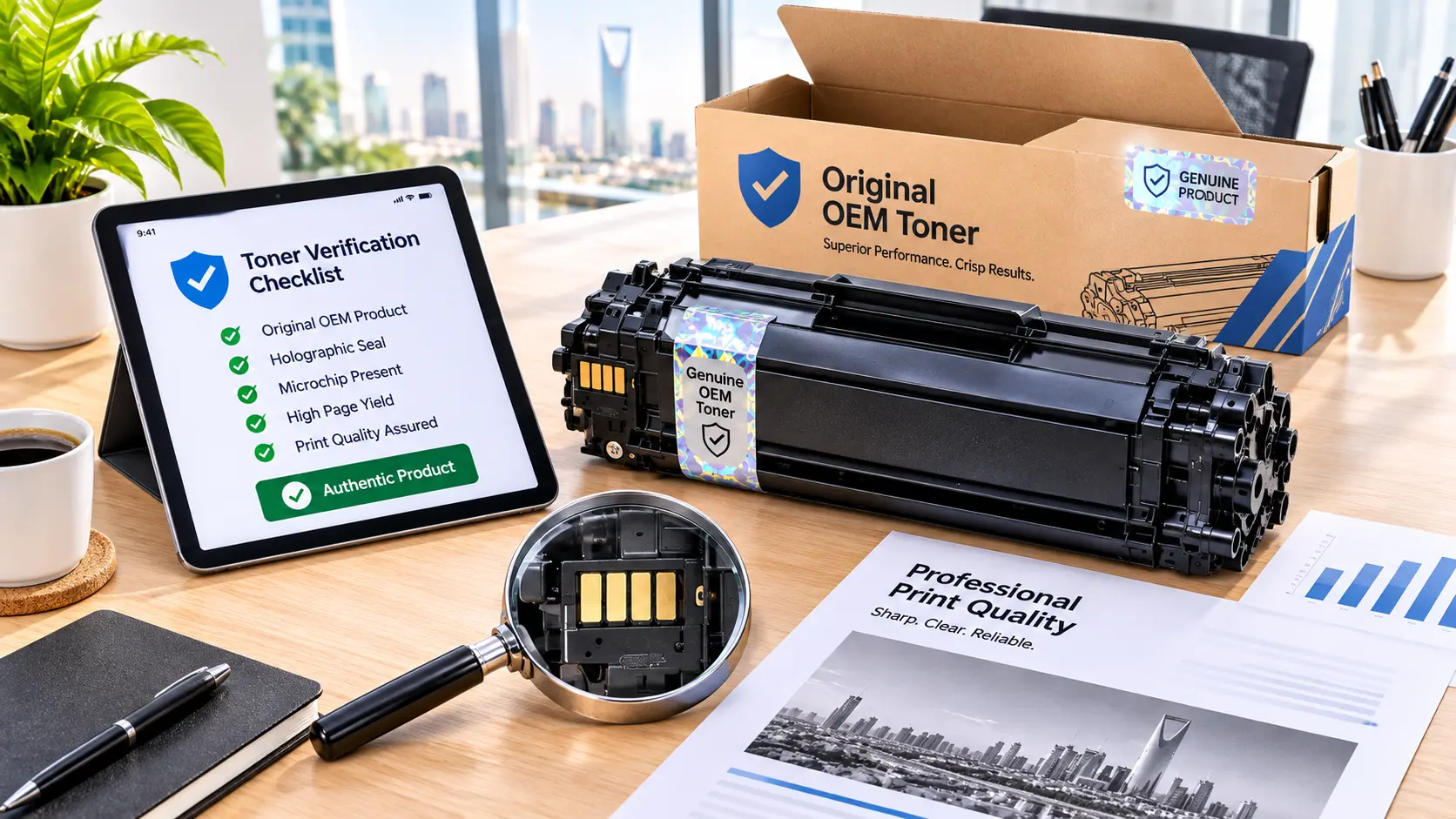
Quick Summary: Comparing original vs compatible toner comes down to four measurable factors: verifiable supply origin, serialized batch traceability, standardized ISO/IEC page yield, and clear hardware support terms.
Quick Summary: Choosing between 70 vs 80 gsm paper depends on document readability, printer feed limits, and double sided ink coverage rather than assuming heavier paper solves every