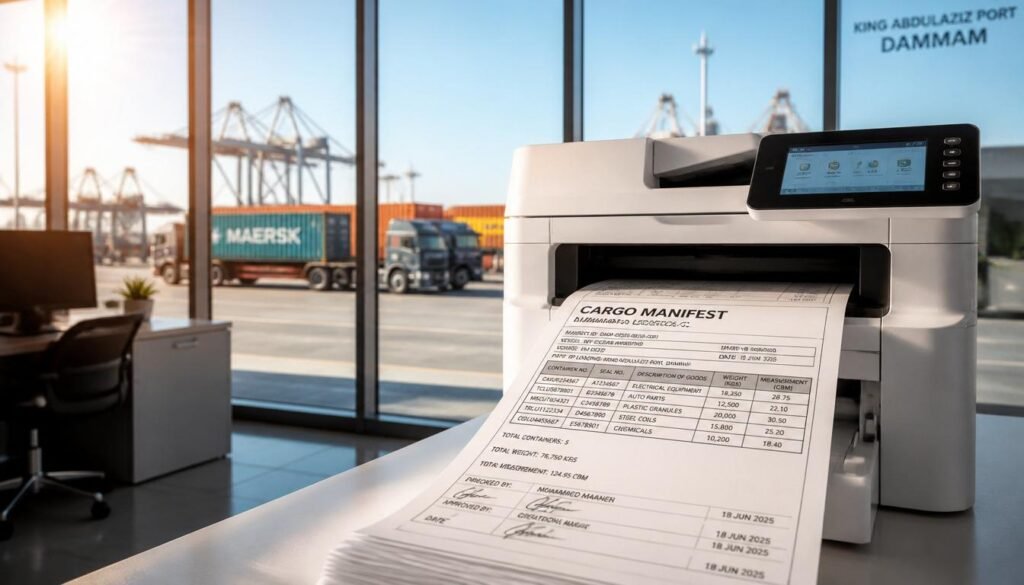
Managed Print Services Dammam: Solutions for Logistics
Hasnain
5 mins read
Table of Contents
Every morning, logistics operations across Dammam print hundreds sometimes thousands of documents before the first truck leaves the yard. Waybills, cargo manifests, delivery orders, customs declarations, packing lists. These are not optional paperwork. They move shipments through King Abdulaziz Port, satisfy customs requirements, and keep supply chains running on time.
Yet most logistics companies in the Eastern Province have zero visibility over what their printing actually costs them. Printers break down at the worst moments. Toner runs out mid-shift. IT staff spend time on printer calls instead of infrastructure. The result is avoidable disruption and unchecked spending.
Managed print services MPS solve all of this under a single structured contract. This guide explains what MPS is, why it fits logistics operations in Dammam, and what to look for when choosing a provider in the region.
What Are Managed Print Services?
Managed print services (MPS) is a vendor-managed model where a provider takes full responsibility for your organization’s entire print environment. That includes the printers, consumables, maintenance, and reporting all handled externally, typically under a monthly contract.
Rather than your team reacting to printer failures, ordering toner manually, and guessing at print costs, an MPS provider does it proactively. The core components of a standard MPS arrangement include:
Print audit and fleet assessment — a baseline review of how many devices you have, where they sit, how they are used, and what they cost
Device monitoring — real-time visibility over every printer on the network, with alerts before problems become failures
Toner and consumable auto-replenishment — supplies are delivered before stock runs out, based on actual usage data
On-site maintenance with defined SLAs — a technician responds within an agreed window, not whenever one becomes available
Monthly reporting — data on pages printed, cost per department, device utilisation, and waste
Providers offering MPS solutions in Saudi Arabia range from global brands like HP, Canon, Xerox, and Toshiba to regional specialists with on-the-ground technician teams. What matters more than the brand is whether the provider can deliver in your specific area and for logistics in Dammam, local support capability is non-negotiable.
Why Logistics Companies in Dammam Are Switching to MPS
Dammam is not just a city it is the logistics centre of Saudi Arabia. King Abdulaziz Port is one of the busiest container ports in the Middle East. The Eastern Province hosts major freight forwarders, third-party logistics providers, customs clearance agents, and warehousing operations serving both domestic and export markets. Under Vision 2030, the pressure to run leaner, more efficient logistics operations is only increasing.
In this environment, printing failures have consequences that go beyond inconvenience. Here is where unmanaged print environments create real operational risk:
1. High Daily Print Volumes With No Cost Tracking
A mid-size logistics company in Dammam might process 500 to 2,000 printed documents per day waybills, bills of lading, delivery notes, customs forms, and shipping labels. Without a managed system, nobody knows the total cost. Print spend sits buried in consumables budgets, IT maintenance budgets, and ad-hoc purchase orders. MPS consolidates that into one visible monthly figure.
2. Printer Downtime Equals Delayed Shipments
In logistics, timing is the product. A printer failure at a dispatch desk or a toner outage in a customs office does not pause operations it creates a backlog that ripples through the entire day’s schedule. MPS providers monitor devices continuously and dispatch technicians before failures cause stoppages. Preventive maintenance replaces reactive firefighting.
3. IT Teams Are the Wrong People for Printer Problems
Most logistics companies do not have a dedicated print technician. Printer issues fall to IT staff, who are pulled away from network infrastructure, cybersecurity, and systems administration to deal with paper jams and toner installations. MPS removes this burden entirely. The MPS provider handles all first-line and technical support, freeing your IT team for work that actually requires their skills.
4. Compliance Documents Must Print Correctly — Every Time
Customs declarations, import permits, and cargo manifests submitted to Saudi Customs (ZATCA) or port authorities must be clear, complete, and legible. A faded print caused by a depleted toner cartridge, or a document error caused by a malfunctioning printer, creates compliance delays and potential fines. MPS ensures consumables are always at the right level and devices are maintained to the manufacturer’s print quality standards.
5. Uncontrolled Print Spend Across Multiple Sites
Many logistics operations in Dammam run across multiple locations a head office, a port-side operations centre, and one or more warehouses in areas like Jubail or Al Khobar. Each site manages printing differently. MPS applies consistent policy, pricing, and reporting across every location, giving management a unified view of print costs across the entire operation.
Key Features of MPS Solutions for Logistics Operations
Not all MPS contracts are the same. For logistics companies in Dammam, these are the features that deliver the most operational value:
Print Audit and Fleet Assessment
Before any MPS engagement starts, a provider audits your existing print environment. They map every device multifunction printers (MFPs), standalone laser printers, label printers and assess usage volumes, running costs, and coverage gaps. This audit often reveals that companies have more printers than they need in some areas and critical gaps in others. It is the foundation for a right-sized fleet.
Automated Toner and Supply Replenishment
Toner levels are monitored remotely. When a cartridge reaches a defined threshold, a replacement is dispatched automatically without anyone placing a manual order. For a logistics operation where a shift supervisor should not be thinking about toner levels at 3am, this is the feature that removes the most day-to-day friction. Supplies Hub stocks a full range of compatible and original toner cartridges. Browse the
Supplies Hub stocks a full range of compatible and original toner cartridges for common logistics office printers see the Toners & Inks category for available stock.
Preventive Maintenance and SLA-Backed Response
Under an MPS contract, maintenance is scheduled before problems occur, not after. When an issue does arise, the SLA defines the maximum response time typically same-day or next-day for Dammam and the surrounding Eastern Province area. This is a significant operational advantage over relying on ad-hoc repair calls with unpredictable lead times. For businesses needing flexible hardware solutions, rental machine options can complement or replace owned devices within an MPS framework.
Secure Print Release
Logistics operations handle commercially sensitive data cargo values, client names, shipping routes, and pricing. Secure print release holds a document in a print queue until the authorized user authenticates at the device. This prevents documents from sitting unattended in output trays and reduces the risk of data exposure in shared office environments.
Usage Reporting and Cost Allocation
MPS platforms generate monthly reports showing exactly which departments or cost centres printed what, and at what cost. For logistics companies billing clients by project or running cost centres per client account, this level of granularity enables accurate chargebacks and tighter financial control. Some platforms integrate directly with ERP systems such as SAP, eliminating manual reconciliation.
Remote Device Monitoring
Every printer on the managed fleet is connected to the provider’s monitoring platform. Issues such as paper feed errors, low consumables, firmware faults, or connectivity drops are flagged automatically often before the user at that printer is even aware of a problem. This is particularly valuable for large warehouse environments where a single printer failure at a loading bay can slow an entire shift.
For the broader technology infrastructure that supports print and document workflows, Supplies Hub also carries
For the broader technology infrastructure that supports print and document workflows, Supplies Hub carries a range of networking products suited to logistics office environments.
MPS vs Managing Printers In-House: What Actually Costs More?
The most common objection to MPS is cost. Many logistics managers assume that owning and managing printers in-house is cheaper than paying a monthly MPS contract. In most cases, this assumption does not hold when you account for all the actual costs involved.
Factor
In-House Management
Managed Print Services (MPS)
Monthly cost
Unpredictable — spikes with breakdowns
Fixed contract rate, easy to budget
Maintenance
Reactive — call IT when it breaks
Proactive — issues caught before failure
Toner & supplies
Manual ordering, risk of running out
Auto-replenishment, zero stockout risk
IT team burden
High — printer calls distract IT staff
Low — handled by MPS provider
Device visibility
None — no usage data
Full dashboard: usage, cost, alerts
Scalability
Slow — new printers = new budget requests
Fast — add/remove devices on contract
SLA / uptime
No guarantee
Defined response time, often same-day
The real cost of in-house print management includes printer hardware depreciation, toner and paper purchases, IT staff time, third-party repair call-outs, and the operational cost of downtime. When these are added together, the total cost of ownership typically exceeds a comparable MPS contract and without any of the service guarantees.
Logistics firms that have transitioned to MPS commonly report print cost reductions in the range of 20 to 30 percent, with the additional benefit of eliminating unplanned maintenance spend and IT distraction. The financial case is usually clear within the first quarter of a managed contract.
What to Look for in a Managed Print Services Provider in Dammam
The MPS market in Saudi Arabia includes both global vendors and regional specialists. When evaluating providers for a Dammam-based logistics operation, use this checklist to separate capable partners from those who cannot deliver at the pace your operation demands:
On-site SLA response time in the Eastern Province — can they reach your site same-day or next-day? A national provider with no technicians based in Dammam is not suitable for time-critical logistics environments.
Brand-neutral support — can they service HP, Canon, Xerox, and Toshiba devices, or only their own brand? Logistics companies often have a mixed fleet built up over time, and a provider locked to one manufacturer creates gaps.
Toner and consumables included — is the contract all-inclusive, or does consumable supply carry additional cost? Confirm what is inside the monthly fee before signing.
Monthly reporting and dashboard access — you should receive clear, readable data on print volumes, costs, and device status each month. Without this, the visibility benefit of MPS is lost.
Scalability — as your logistics operation grows, adds warehouses, or expands its fleet, can the MPS contract accommodate new devices quickly? Flexible contracts are far more practical than fixed-device agreements in a growth environment.
Local presence or partnership — a provider with actual operations or partner technicians in Dammam will always outperform a remote-managed service when something needs a physical fix.
Asking these questions before committing to any MPS contract will prevent the most common pitfall choosing a provider based on price alone, only to find their response times and coverage do not match the demands of a logistics operation.
Start Managing Your Print Environment | Not Firefighting It
Managed print services give logistics companies in Dammam something they rarely have with unmanaged print environments: control. Control over cost, uptime, supply levels, and data. For an industry where margins depend on operational precision, that control is not a luxury it is a competitive requirement.
The right starting point is a print audit. Before committing to any contract or changing any hardware, understand exactly what your current environment costs and where the gaps are. Most reputable MPS providers in the region will conduct this audit at no charge as part of the engagement process.
If your logistics operation in Dammam is still managing printers reactively, the cost of staying in that model will continue to compound. The question is not whether MPS makes financial sense the data consistently shows it does. The question is when to start.
Explore Supplies Hub’s Managed Printing Services (MPS) solutions for businesses in the Eastern Province, or browse the full range of
Browse the full range of office machines and printers available for logistics and office environments across Dammam.
Hasnain
SEO & Content Marketing Specialist focused on building search-driven brands through strategic content, organic growth, and audience-first storytelling. Skilled in modern SEO, content strategy, and creating scalable digital experiences.
Hasnain
SEO & Content Marketing Specialist focused on building search-driven brands through strategic content, organic growth, and audience-first storytelling. Skilled in modern SEO, content strategy, and creating scalable digital experiences.
Summary: An e-procurement system helps businesses control purchasing through digital requests, approvals, supplier management, purchase orders, and spend tracking. For Saudi companies managing multiple suppliers, branches, and recurring
If your business relies on chaotic paper trails, lost email threads, and manual invoice matching, you are already falling behind. Traditional purchasing methods simply cannot keep up with
Inefficient purchasing and unmanaged tail spend silently cost businesses millions of riyals every year. If your procurement team is drowning in manual data entry instead of building strategic