How MPS Solves Print Security & Compliance for KSA Finance Sector
Hasnain
5 mins read
Table of Contents
Summary
“The KSA finance sector faces unique print security threats. Discover how Managed Print Services (MPS) provides a robust framework for data protection and regulatory compliance.”
Our guide to secure printing solutions explains how MPS helps KSA banks and finance firms boost security, ensure compliance, and improve efficiency.
In the fast-paced world of finance in the Kingdom of Saudi Arabia, digital fortresses are built to protect against cyber threats. But what about the quiet, unassuming device in the corner of your office? The printer. While often overlooked, your print infrastructure can be the weakest link in your entire security chain, leaving sensitive financial data exposed.
For banks, insurance companies, and investment firms across KSA, the stakes are incredibly high. The challenge is twofold: safeguarding invaluable client data and strictly adhering to the regulatory frameworks set by authorities like the Saudi Central Bank (SAMA) and the National Cybersecurity Authority (NCA).
The good news? There’s a comprehensive framework designed to turn this vulnerability into a strength. This article will explore how Managed Print Services (MPS) deliver the secure printing solutions your financial institution needs to achieve robust security, guaranteed compliance, and enhanced operational efficiency.
The Unseen Threat: Print Vulnerabilities in the KSA Finance Sector
Financial data, from client account details to investment strategies, is a high-value target. While you’ve secured your servers and networks, your print environment might be riddled with security loopholes you haven’t considered.
Common risks include:
Unclaimed Confidential Documents: A sensitive report is printed and then forgotten at the printer tray, available for anyone to see or take.
Unauthorized Access: An employee prints a financial statement or client list they are not authorized to view, with no system to stop or track it.
Unsecured Network Traffic: Print jobs sent over the network without encryption can be intercepted by malicious actors, exposing the data in transit.
Outdated Device Firmware: Every printer is a computer. If its software (firmware) isn’t patched, it contains known security flaws that can be exploited to gain access to your network.
Zero Visibility: Without a tracking system, you have no way of knowing who printed what, when, or from which device. This makes it impossible to conduct a forensic audit after a suspected breach.
Print Security by the Numbers: The Hidden Costs of Inaction
The Statistic
The Sobering Reality
$8.07 Million
The average cost of a data breach in the Middle East in 2023. This includes regulatory fines, lost business, and remediation costs. (Source: IBM Cost of a Data Breach Report 2023)
61%
The percentage of organizations that have experienced at least one data loss due to insecure printing practices. (Source: Quocirca’s Print Security Landscape 2023)
277 Days
The average time it takes to identify and contain a data breach. The longer it takes, the more the costs multiply. (Source: IBM Cost of a Data Breach Report 2023)
74%
The percentage of data breaches that involve a human element, such as employee error or misuse. (Source: Verizon 2023 Data Breach Investigations Report)
The Compliance Mandate: SAMA & NCA Frameworks
For financial institutions in Saudi Arabia, these risks aren’t just a business concern they are a compliance nightmare. SAMA and the NCA have established strict cybersecurity controls, such as the NCA’s Essential Cybersecurity Controls (ECC). These frameworks mandate robust data protection, access control, and monitoring. Failure to comply can result in severe penalties and reputational damage.
Think of it as a holistic, proactive partnership to manage every single aspect of your printing environment. It goes far beyond simply fixing broken printers or refilling toner. A true MPS provider becomes an extension of your IT and security team.
The core pillars of MPS include:
Assessment & Optimization: Analyzing your current print fleet to identify risks, inefficiencies, and cost-saving opportunities.
Proactive Management: Monitoring your devices 24/7 to prevent issues, perform maintenance, and automate supplies fulfillment so you never run out of toner.
Security & Compliance: Implementing a multi-layered security strategy to protect your devices, documents, and data.
This security layer is where Managed Print Services truly transform your business operations.
The Solution in Action: How MPS Delivers Secure Printing Solutions
Let’s move from theory to practice. Here is exactly how an MPS strategy tackles the security and compliance challenges faced by the KSA finance sector.
1. Implementing “Pull Printing” for User Authentication
The single most effective way to eliminate the risk of unclaimed documents is through secure print release, also known as “pull printing.”
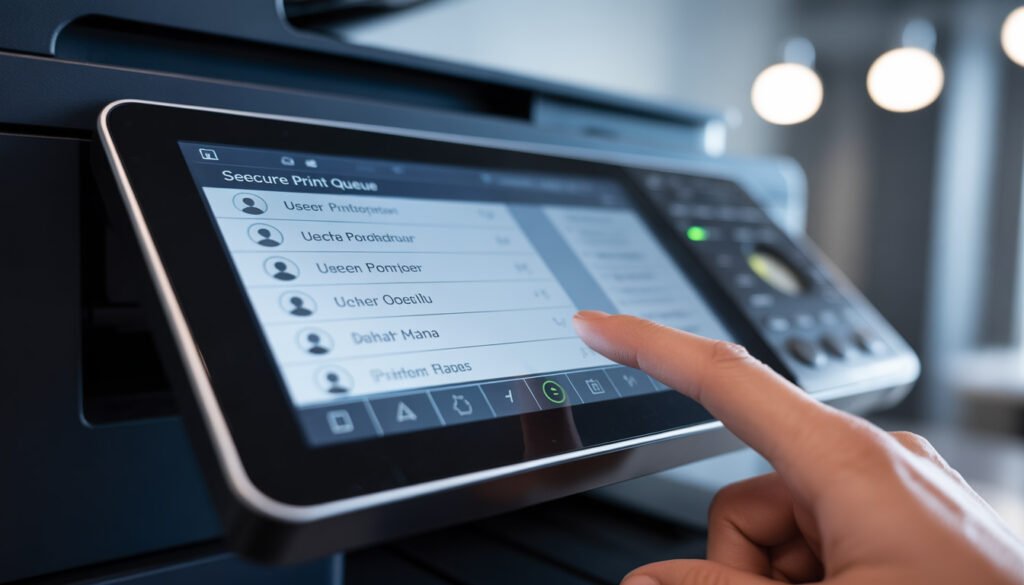
How it works: When a user prints a document, it isn’t immediately released. Instead, it’s held in a secure print queue. To retrieve the document, the user must walk up to any printer on the network and authenticate themselves using a company ID card, a PIN code, or even a biometric scan. Only then is the document printed.
The Benefit: This simple change ensures documents are never left exposed on the printer tray. It guarantees that the person who printed the document is the one who collects it, creating a direct chain of custody.
2. End-to-End Data Encryption
An MPS provider ensures your data is protected at all times. This happens in two key ways:
Data-in-Transit: The print job is encrypted as it travels from the user’s computer across the network to the printer, making it unreadable to anyone trying to intercept it.
Data-at-Rest: Many modern printers have internal hard drives. MPS ensures these drives are encrypted, so even if a device is stolen, the stored data remains secure and inaccessible.
The Benefit: Encryption makes your print data useless to cybercriminals, both inside and outside your network.
3. Proactive Device Hardening and Fleet Monitoring
Your printer fleet consists of multiple network endpoints. An MPS provider treats each one as a critical asset to be secured. This process, known as “device hardening,” involves:
Closing unused network ports.
Disabling unnecessary services and protocols.
Regularly updating firmware to patch security vulnerabilities.
Continuously monitoring the fleet for suspicious activity and potential threats.
The Benefit: Your printers are transformed from potential entry points into hardened, secure, and actively monitored components of your IT infrastructure.
4. Creating Audit Trails for Effortless Compliance
For the finance sector, proving compliance is just as important as being compliant. MPS provides the documentation you need.
How it works: The system creates detailed logs of all print activity. These audit trails can show exactly who printed what document, from which device, and at what time. You can generate custom reports to track printing by user, department, or device.
The Benefit: During a SAMA or NCA audit, you can instantly provide clear, concise evidence that you have robust controls in place for document access and data handling, making the audit process smooth and successful.
Beyond Security: The Compounding Benefits of MPS
While security and compliance are the primary drivers for the finance sector, the benefits of MPS don’t stop there.
Significant Cost Reduction: By optimizing your fleet and eliminating wasteful printing (like unclaimed documents), companies often see print-related costs drop by up to 30%.
Increased Productivity: Proactive maintenance and automated supplies mean your printers have higher uptime. Your IT team is also freed from handling daily printer issues to focus on more strategic initiatives.
Sustainability: Reducing paper, toner, and energy consumption helps your organization achieve its Corporate Social Responsibility (CSR) goals.
Choosing the Right MPS Partner in Saudi Arabia
Implementing a successful MPS strategy depends heavily on choosing the right partner. You need a provider who understands the unique demands of the KSA market.
Local KSA Expertise: Deep knowledge of the local business landscape and the specific requirements of SAMA and NCA.
Experience in Finance: A proven track record of implementing secure printing solutions for banks and financial firms.
A Comprehensive Security Approach: The ability to deliver on all the security layers discussed, from pull printing to device hardening.
Reliable Support: A commitment to providing prompt, on-the-ground support to keep your operations running smoothly.
Secure Your Print Environment Today
In the Saudi Arabian finance sector, security cannot be an afterthought. Your printers are a vital part of your data infrastructure, and they need to be treated with the same level of security as your servers and firewalls.
Secure printing solutions, delivered through a comprehensive Managed Print Services strategy, are no longer a luxury they are a strategic necessity for risk management, regulatory compliance, and operational excellence.
Is your print environment truly secure and compliant? Don’t leave it to chance. Contact the experts at Supplies Hub today for a free, no-obligation print security assessment to identify your vulnerabilities.
Hasnain
SEO & Content Marketing Specialist focused on building search-driven brands through strategic content, organic growth, and audience-first storytelling. Skilled in modern SEO, content strategy, and creating scalable digital experiences.
Hasnain
SEO & Content Marketing Specialist focused on building search-driven brands through strategic content, organic growth, and audience-first storytelling. Skilled in modern SEO, content strategy, and creating scalable digital experiences.
Summary: An e-procurement system helps businesses control purchasing through digital requests, approvals, supplier management, purchase orders, and spend tracking. For Saudi companies managing multiple suppliers, branches, and recurring
If your business relies on chaotic paper trails, lost email threads, and manual invoice matching, you are already falling behind. Traditional purchasing methods simply cannot keep up with
Inefficient purchasing and unmanaged tail spend silently cost businesses millions of riyals every year. If your procurement team is drowning in manual data entry instead of building strategic