Cost of Plotter Ownership vs Rental: A Saudi AEC Guide
Hasnain
5 mins read
Table of Contents
Summary
“Discover why leading Saudi construction firms are abandoning traditional equipment procurement. We break down the true, hidden Total Cost of Ownership (TCO) for wide-format printing and explain how renting plotters can protect your working capital, eliminate downtime, and keep your firm agile for Vision 2030 megaprojects.”
The rapid pace of Saudi Arabia’s construction boom demands unprecedented agility. With the Kingdom driving toward Vision 2030, firms engaged in megaprojects like NEOM, the Red Sea Project, and Qiddiya are scaling their operations faster than ever before. However, scaling fast requires smart procurement. Why are leading AEC (Architecture, Engineering, and Construction) firms rethinking their equipment procurement strategies?
When assessing wide-format printing capabilities, many procurement managers fall into the trap of only looking at the sticker price of a new machine. The reality is that the true cost of plotter ownership vs rental is a complex equation involving capital expenditure, operational flexibility, and hidden maintenance burdens.
This comprehensive guide breaks down the true financial and operational impact of your wide-format printing choices in the Saudi market.
Why is the Total Cost of Ownership (TCO) Often Miscalculated?
When a construction firm decides to buy a plotter outright, the purchasing department often celebrates the negotiated retail price. However, this represents the “Iceberg Effect” of hardware procurement. Industry data suggests that the initial purchase price of wide-format printers represents only 20% to 30% of the Total Cost of Ownership (TCO) over a standard four-year lifespan.
Here are the hidden costs of owning a plotter that often derail a project’s budget:
1. Rapid Technology Depreciation
Technology in the printing sector evolves rapidly. The heavy-duty plotter you purchase today will likely be obsolete in three to four years. As firmware updates cease and OEM (Original Equipment Manufacturer) parts become scarce, the resale value of your owned machine plummets. When you own the asset, your company absorbs 100% of this depreciation.
2. Out-of-Warranty Repairs and Spare Parts
Most plotters come with a standard one-year warranty. In the harsh environments of Saudi construction site offices where dust, heat, and continuous operation take their toll printheads and belts wear out faster than in corporate environments. Once the warranty expires, the cost of flying in a specialized technician and sourcing proprietary spare parts falls entirely on your firm.
3. Retail Consumables vs. Contract Rates
When you own a plotter without a managed service agreement, your team is forced to procure ink, toner, and specialized media at fluctuating retail prices. Conversely, rental and lease agreements typically bundle consumables at fixed, wholesale contract rates, shielding your project from supply chain inflation.
4. The Burden on IT Labor
Your IT personnel are highly paid professionals tasked with managing cybersecurity, network infrastructure, and enterprise software. When a wide-format printer goes down during a critical tender submission, your IT team is forced to pivot to hardware troubleshooting. This diversion of skilled labor is a massive, often untracked operational cost.
Looking for insights on managing maintenance for your broader fleet? Read our guide on the benefits of AMC Contracts for Copiers.
How Does Plotter Rental Protect Your Project Cash Flow?
For Saudi construction firms, the most compelling argument in the “Cost of Plotter Ownership vs Rental” debate is the preservation of capital. Moving your wide-format printing from a Capital Expenditure (CAPEX) to an Operational Expenditure (OPEX) model fundamentally changes how your business operates.
Preserving Working Capital for Vision 2030
Saudi Vision 2030 has created a landscape where the ability to mobilize quickly is a massive competitive advantage. When you rent a plotter, you preserve significant cash flow. Instead of tying up tens of thousands of Riyals in depreciating plastic and metal, your firm can allocate those funds toward what actually grows the business:
Procuring raw construction materials.
Hiring specialized engineering talent.
Maintaining healthy emergency reserves.
Bidding on additional regional projects.
Predictable Monthly Budgeting
Plotter rental transforms a volatile, unpredictable cost center into a stable, fixed monthly line item. Your finance department will know exactly what the wide-format printing budget is for the entire fiscal year. This predictability is vital for accurate project cost estimation and protecting your profit margins.
“In modern construction, agility is capital. Tying up cash in printing hardware that will be obsolete in three years restricts a firm’s ability to pivot between project sites. Moving to an OPEX model is no longer just an IT decision; it is a financial imperative.”— Enterprise Procurement Specialist
When Should a Construction Firm Choose Rental Over Ownership?
Is renting always the right answer? Not necessarily. But in the dynamic landscape of Middle Eastern construction, specific scenarios make rental the undeniable choice.
Scenario 1: Short-to-Medium Term Site Offices
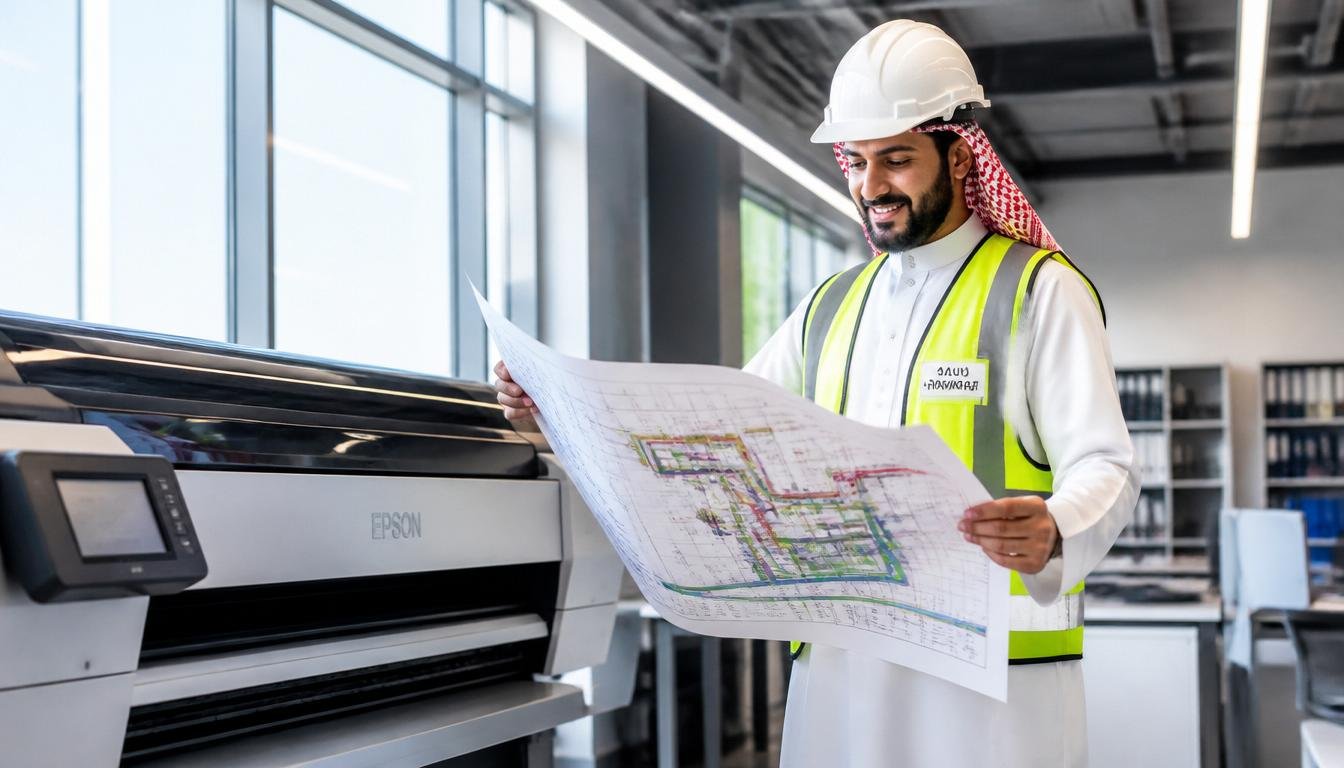
Consider a 24-month infrastructure project outside of Riyadh. Setting up a temporary site office requires immediate printing capabilities for A0 and A1 CAD drawings. Buying a plotter for this site means that when the project concludes, you are left with the logistical nightmare of demobilizing the machine, finding storage for it, or attempting to sell a used, heavily worn printer. Renting allows you to simply return the equipment when the site office closes.
When a Saudi contractor wins multiple simultaneous bids, printing capacity must scale overnight. Going through the traditional CAPEX approval process, waiting for capital allocation, and enduring long shipping lead times can bottleneck the engineering team. Rental agreements bypass capital approval boards because they are categorized as operational expenses, allowing for deployment in a matter of days.
Scenario 3: Risk Mitigation and Zero Downtime
In the AEC industry, timelines are uncompromising. A broken plotter during a final architectural tender submission can cause catastrophic delays. When you rent, you are not just renting a machine; you are renting an outcome. Reputable rental providers in Saudi Arabia offer strict Service Level Agreements (SLAs). If the plotter cannot be fixed within a specified window (often 4 to 8 hours), a replacement machine is deployed immediately. The risk of downtime is transferred entirely to the vendor.
The Hybrid Approach: A Fresh Perspective on Fleet Management
For Tier 1 construction firms and massive architectural conglomerates, the answer to the “Rent vs Buy” question is often a strategic mix of both. We call this the Hybrid Approach.
Top-tier firms rarely operate on a strict binary. Instead, they optimize their fleet based on location stability:
The Corporate Headquarters (Ownership): For the main engineering hub in Jeddah or Riyadh, where print volume is incredibly high, consistent year-round, and the environment is climate-controlled, purchasing a flagship, heavy-duty production plotter makes financial sense. The company can absorb the depreciation over a long period because the asset rarely moves.
The Project Sites (Rental): For the satellite offices springing up around NEOM or the Red Sea, the firm utilizes rental agreements. This provides the agility to scale up or down based on the project’s lifecycle, avoids the costs of mobilizing heavy hardware, and ensures that remote teams have access to on-site technical support without deploying the firm’s own IT staff to the desert.
This hybrid model ensures that capital is invested wisely at the core, while maintaining hyper-agility at the operational edges.
Ownership vs. Rental: A 3-Year Comparative Breakdown
To truly understand the cost of plotter ownership vs rental, we must look at a multi-year financial projection. Below is a realistic framework for comparing costs over a 36-month period for a mid-to-high volume AEC firm in Saudi Arabia.
Cost Factor
Owning a Plotter (CAPEX)
Renting a Plotter (OPEX)
Upfront Cost
High (100% of asset value upfront)
Zero (First month’s rent only)
Asset Depreciation
Firm absorbs massive loss in value
None (Risk borne by provider)
Annual Maintenance (AMC)
Paid separately (Often expensive out-of-warranty)
Included in monthly fee
Spare Parts & Printheads
Paid out of pocket at retail markup
Included in SLA coverage
Consumables (Ink)
Variable, subject to market inflation
Fixed contract pricing
Technology Upgrades
Requires buying a brand new machine
Easy upgrade at contract renewal
Balance Sheet Impact
Asset liability, ties up capital
Fully tax-deductible operating expense
Downtime Risk
High (Dependent on internal IT limits)
Low (Guaranteed by SLA response times)
When you aggregate the cost of the hardware, the AMC, the inevitable replacement of expensive printheads, and the hidden cost of IT labor over three years, ownership frequently exceeds the cost of a comprehensive rental agreement by 15% to 25%, all while providing significantly less operational flexibility.
Why Partner with Supplies Hub for Your AEC Printing Needs?
Understanding the true cost of plotter ownership vs rental is the first step toward optimizing your firm’s procurement strategy. The next step is finding a partner who understands the unique pressures of the Saudi construction sector.
At Supplies Hub, we don’t just supply equipment; we architect printing environments that scale with your ambitions.
Why Saudi Firms Trust Supplies Hub:
Deep Sector Expertise: We understand the difference between printing a standard office memo and producing highly detailed, color-accurate A0 architectural renderings.
Rapid Deployment: Whether your site office is in the heart of Riyadh or a remote development zone, our logistics network ensures you get the equipment you need, when you need it.
Ironclad SLAs: We know that in construction, time is money. Our proactive maintenance and rapid-response repair teams ensure your engineering team never misses a deadline due to hardware failure.
Transparent OPEX Billing: No hidden fees, no surprise invoices for spare parts. We provide predictable, fixed monthly billing that keeps your finance department happy.
(Need to secure your project documents? Explore our Secure Printing Solutions to protect sensitive architectural IP.)
Conclusion
The Saudi construction landscape is evolving, and traditional, rigid procurement models are being left behind. By shifting from plotter ownership to strategic rental agreements, AEC firms can protect their working capital, eliminate the risks of technology obsolescence, and guarantee maximum uptime for their critical engineering teams.
Don’t let hidden hardware costs eat into your project margins. Contact Supplies Hub today to request a customized Total Cost of Ownership (TCO) audit, and let us build a flexible plotter rental strategy tailored specifically to your next Vision 2030 project.
Hasnain
SEO & Content Marketing Specialist focused on building search-driven brands through strategic content, organic growth, and audience-first storytelling. Skilled in modern SEO, content strategy, and creating scalable digital experiences.
Hasnain
SEO & Content Marketing Specialist focused on building search-driven brands through strategic content, organic growth, and audience-first storytelling. Skilled in modern SEO, content strategy, and creating scalable digital experiences.
Summary: An e-procurement system helps businesses control purchasing through digital requests, approvals, supplier management, purchase orders, and spend tracking. For Saudi companies managing multiple suppliers, branches, and recurring
If your business relies on chaotic paper trails, lost email threads, and manual invoice matching, you are already falling behind. Traditional purchasing methods simply cannot keep up with
Inefficient purchasing and unmanaged tail spend silently cost businesses millions of riyals every year. If your procurement team is drowning in manual data entry instead of building strategic