No products in the cart.

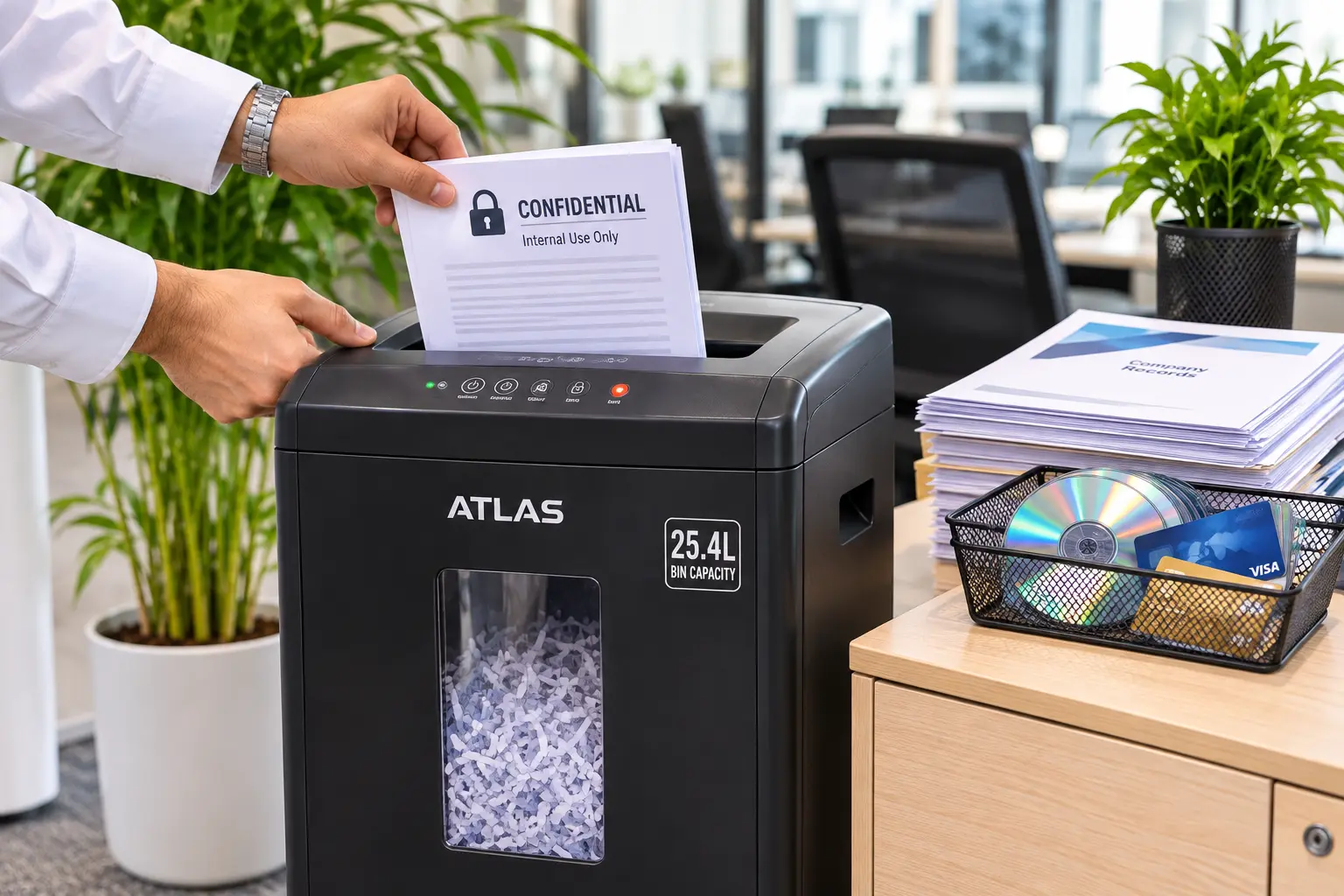
Quick Summary: Learning how to choose a paper shredder for a Saudi office depends on four measurable specifications: DIN 66399 security level, sheet pass capacity, motor duty cycle,

No products in the cart.
Quick Summary:
Learning how to choose a paper shredder for a Saudi office depends on four measurable specifications: DIN 66399 security level, sheet pass capacity, motor duty cycle, and waste bin volume. Cross cut P-4 machines satisfy most Saudi Personal Data Protection Law (PDPL) disposal standards while handling daily departmental batches smoothly.
Walking up to a shared office shredder only to find a red overheat light blinking beside a stack of unshredded contracts is a common frustration in workplaces across Riyadh, Jeddah, and Dammam. When equipment stalls mid-batch, sensitive paperwork gets left in open trays, creating immediate compliance and security exposure.
Selecting the right machine eliminates bottlenecks and keeps physical document destruction effortless for your team. In this paper shredder buying guide, we break down cut technologies, daily batch sizing, run time limits, and bin capacities using verified specifications from stocked office models.
Physical documents remain a primary source of corporate data leaks, even in digitized workplaces. Under Saudi Arabia’s Personal Data Protection Law (PDPL), organizations must protect personal records throughout their entire lifecycle, including permanent disposal. Paper files containing employee Iqama copies, payroll schedules, medical records, client contracts, and bank details cannot simply be tossed into standard recycling bins.
Beyond regulatory accountability, hardware mismatch disrupts daily productivity. Many facility managers select an entry level personal unit for a shared department, leading to frequent paper jams, thermal shut-offs, and premature motor wear. Selecting a machine engineered for your actual paper volume and Saudi electrical standards (220V to 240V at 50 to 60Hz, compliant with SASO requirements) ensures reliable operation without interrupting staff workflows.
“Procurement teams often buy for average Tuesday volume and regret it at quarter-end. Always size your shredder’s duty cycle and sheet pass rating for your heaviest batch day of the month, not your lightest.”— Workplace Equipment Specialist, Supplies Hub KSA
Understanding the difference in a cross cut vs micro cut shredder starts with the international DIN 66399 (ISO/IEC 21964) security standard. This classification measures the exact surface area of shredded particles in square millimeters (mm2) rather than relying on vague marketing labels.
Traditional strip-cut shredders (DIN P-1 and P-2) slice paper vertically into long ribbons between 6 mm and 12 mm wide. A single A4 sheet yields roughly 18 to 35 intact strips that can be pieced back together with minimal effort. Strip-cut units are strictly limited to non-confidential internal drafts and have no place in departments handling client or employee data.
Cross-cut machines use two contra-rotating blade shafts to slice paper both vertically and horizontally into small confetti-like rectangles. Under DIN P-4, each particle must have a surface area of 160mm or less. For example, a 4 × 32 mm cross-cut blade produces 128mm particles, turning a single A4 page into more than 390 separate pieces. Cross-cut technology strikes the practical balance between high security, fast feed rates, and lower blade maintenance, making it the standard choice for KSA corporate offices, HR departments, and accounting teams.
Micro-cut shredders pulverize paper into tiny particles measuring 30mm2 or smaller (such as 2 × 15 mm or 3 × 9 mm), generating over 2,000 pieces from one A4 sheet. While micro-cut offers superior protection for classified legal files, defense contracts, and executive research, its tighter blade tolerances reduce sheet pass speed and require more frequent blade lubrication.
Modern offices dispose of more than paper. Expired corporate access badges, credit cards, and archived CDs or DVDs carry sensitive magnetic or digital data. Dedicated multi-media cutting slots ensure plastic cards and optical discs are destroyed cleanly without dulling the primary paper cutters.
| Specification | Strip-Cut (DIN P-1 / P-2) | Cross-Cut (DIN P-3 / P-4) | Micro-Cut (DIN P-5+) |
| Maximum Particle Area | Up to 2,000mm | 160mm or less (P-4) | 30mm or less (P-5) |
| Particles per A4 Sheet | 18 to 35 long strips | 390+ confetti pieces | 2,079+ fine particles |
| Throughput and Feed Speed | Fastest | High (built for daily batches) | Moderate (tighter blade tolerances) |
| Blade Maintenance Need | Low | Moderate (regular oiling) | High (frequent oiling and dust clearing) |
| Best KSA Office Fit | Non-sensitive internal notes | HR, finance, contracts, PDPL compliance | Classified legal, defense, R&D records |
Evaluating office shredder capacity requires looking closely at rated sheets per pass alongside the actual paper weight used in your workplace. Manufacturers test sheet capacity using crisp, unstapled 70gsm or 80gsm A4 sheets. If your office regularly prints double-sided reports on thicker stock, you can review our guide on choosing between 70 vs 80 GSM office paper to see how paper weight affects machine feeding.
In real office conditions, folded sheets count as two layers, and stapled packets or paper clips add mechanical resistance. Always apply a 20% safety buffer below the stated maximum sheet rating to prevent jams and extend gear life.
For individual executives, private consultants, or home-office workstations that shred a few confidential pages at the end of the day, a compact 5-sheet machine is sufficient. The Atlas Cross Cut Shredder 5 Sheets 4x32mm (SKU: SHD-ATL-5SHT-01) slices up to 5 sheets of A4 paper per pass into 4 × 32 mm cross-cut particles while fitting discreetly beside a desk.
When two to five staff members share a workstation such as an HR pod, clinic reception, or branch administration desk capacity must handle thicker packets and mixed media. The Atlas Paper Shredder Paper CD And Cards 25.4L 9 Sheets (SKU: SHD-ATL-9SHT-01) processes up to 9 sheets per pass while destroying CDs and credit cards, cutting standing time in half compared to entry-level deskside units.
Busy accounting departments, legal practices, and corporate headquarters clear thick client dossiers, tax filings, and stapled contracts in concentrated bursts. Standing at a small machine feeding five pages at a time wastes valuable administrative hours. The Atlas 20-Sheet Heavy-Duty Cross-Cut Paper, CD & Card Shredder (SKU: SHD-ATL-20SHT-01) handles up to 20 sheets of 80gsm A4 paper in a single pass, powering straight through staples, small paper clips, credit cards, and optical discs.
Before finalizing any model, verify that the paper entry throat measures at least 220 mm wide so standard 210 mm A4 sheets slide in flat without corner folding.
The shredder duty cycle defines how long a machine can run continuously before its motor must pause to cool down. Every cross-cut shredder generates friction heat between interlocking steel blades; without thermal protection, sustained friction warps gears and burns out motor windings.
Compact personal and small-office shredders typically operate on short burst cycles, such as 2 to 5 minutes of continuous shredding followed by a 15 to 30 minute cool-down period. Heavy-duty departmental units incorporate larger motors, internal cooling fans, and dedicated overheat indicator lights to sustain longer continuous sessions.
Aligning your hardware capacity with peak monthly demand is a core principle of effective office supplies RFQ and vendor evaluation, ensuring your procurement team avoids early equipment replacements.
Waste bin capacity directly controls how often facilities or administrative staff must interrupt their work to empty shredded confetti. Because cross-cut particles pack far more densely than long strip-cut ribbons, a well-sized cross-cut bin holds substantially more shredded sheets before triggering a bin-full sensor.
Personal deskside units use lift-off cutter heads over compact bins. While ideal for single-user offices with tight floor space, lifting the heavy motor head becomes tedious if multiple people use the machine daily.
For small offices and reception areas, a mid-sized bin minimizes daily bag changes without dominating the room. The Atlas 9-Sheet Shredder pairs its 9-sheet feed capacity with a 25.4-liter waste bin, giving small teams ample room for regular paper, card, and disc disposal.
In high volume corporate departments, ergonomic bin design matters just as much as capacity. The Atlas 20-Sheet Heavy-Duty Shredder features a 33-liter pull-out waste basket mounted on 4 smooth rolling caster wheels. Staff simply slide the front drawer out like a filing cabinet to empty the bag, and teams can roll the unit effortlessly between workstations during archive cleanouts.
To keep cutting shafts running smoothly for years, prioritize models equipped with optical auto start/stop sensors, manual reverse switches for instant jam clearing, and bin-open safety interlocks. Train staff never to feed adhesive shipping labels, sticky notes, or laminated pouches, as melted glue coats cutter teeth. Finally, apply shredder oil across the blades every time you empty the waste bin to clear paper dust and reduce friction.
Matching your office profile to verified machine specifications prevents both under-sizing and unnecessary complexity. Use the matrix below to compare stocked Atlas models available at Supplies Hub across Riyadh, Jeddah, and Dammam.
| Workspace Profile | Daily Batch Volume and Media | Recommended Stocked Model | Verified Hardware Specifications |
| Executive Office or Home Study | Light daily paper notes (up to 50 sheets/day) | Atlas Cross Cut Shredder 5 Sheets (SHD-ATL-5SHT-01) | 5-sheet pass, 4 × 32 mm cross-cut, compact deskside footprint |
| Small Team, HR, or Clinic Desk | Moderate paper plus expired ID cards and CDs | Atlas Paper, CD & Card Shredder 25.4L (SHD-ATL-9SHT-01) | 9-sheet pass, 25.4L waste bin, dedicated paper/CD/card slots |
| Corporate Department, Legal, or Finance | Heavy stapled dossiers, clips, cards, and discs | Atlas 20-Sheet Heavy-Duty Shredder 33L (SHD-ATL-20SHT-01) | 20-sheet pass, 33L pull-out bin, 4 casters, overheat indicator, 220V–240V SASO standard |
You can browse full technical datasheets across our complete lineup of commercial and office paper shredders to match exact dimensions and media capabilities to your facility.
DIN P-4 cross-cut shredding (such as 4 × 32 mm particles) meets everyday corporate confidentiality and Saudi PDPL physical record disposal needs while delivering faster pass speeds. Reserve DIN P-5 micro-cut units for classified legal, defense, or executive research documents.
Heavy-duty commercial cross-cut machines like the Atlas 20-Sheet 33L Shredder use hardened steel cutting shafts and dedicated media slots to destroy staples, small paper clips, plastic credit cards, and CDs or DVDs. Always check individual model specifications before inserting non-paper items.
Lubricate the cutting blades with dedicated shredder oil or lubricant sheets every time you empty the waste bin, or at least twice per month on shared departmental cross-cut machines. Regular oiling prevents paper dust buildup, reduces operating noise, and prevents motor overheating.
Most mid-batch stops happen when the motor exceeds its continuous duty cycle and triggers internal thermal overload protection. Allow the machine to cool down for 15 to 30 minutes before restarting, and consider upgrading to a higher sheet-capacity model if shut-offs happen regularly.
Choosing the right office shredder comes down to four checks: verify DIN P-4 cross-cut security, match sheet pass capacity to your thickest stapled packets, align duty cycle run times with peak monthly purges, and select a pull-out bin volume that suits your floor plan. Upgrading document destruction hardware works best alongside broader workplace technology upgrades to future-proof your KSA office, from managed print workflows to centralized procurement.
What does your daily shredding workload look like? Share your team size, daily document batch volume, and the types of media you dispose of (such as stapled packets, employee ID cards, or optical discs) in the comments below or contact the Supplies Hub team for a tailored product recommendation.

SEO & Content Marketing Specialist focused on building search-driven brands through strategic content, organic growth, and audience-first storytelling. Skilled in modern SEO, content strategy, and creating scalable digital experiences.
SEO & Content Marketing Specialist focused on building search-driven brands through strategic content, organic growth, and audience-first storytelling. Skilled in modern SEO, content strategy, and creating scalable digital experiences.
Related Blogs
Quick Summary: Learning how to choose a paper shredder for a Saudi office depends on four measurable specifications: DIN 66399 security level, sheet pass capacity, motor duty cycle,
Quick Summary: Comparing original vs compatible toner comes down to four measurable factors: verifiable supply origin, serialized batch traceability, standardized ISO/IEC page yield, and clear hardware support terms.
Quick Summary: Choosing between 70 vs 80 gsm paper depends on document readability, printer feed limits, and double sided ink coverage rather than assuming heavier paper solves every