
No products in the cart.
Quick Summary: Learning how to choose a paper shredder for a Saudi office depends on four measurable specifications: DIN 66399 security level, sheet pass capacity, motor duty cycle,


Signing a Managed Print Services agreement should eliminate printer downtime, stabilize office overhead, and free your IT team from endless support tickets. Yet, many organizations across Saudi Arabia discover months into a contract that their expected 20% to 30% savings have evaporated into excess page charges, slow technician visits, and surprise invoices for replacement parts.
The difference between a seamless print infrastructure and a recurring budget drain comes down to your Service Level Agreement (SLA). Standard vendor contracts are naturally drafted to protect the provider’s margins, not your daily operations. This guide walks you through the exact contractual fine print, critical metrics, and negotiation points needed to secure an enterprise agreement that genuinely protects your business.
Most print contracts look appealing on the surface because they offer a low base rate or an attractive initial hardware lease. The hidden cost appears later through ambiguous definitions, unmonitored variable fees, and restrictive volume quotas. When key terms are loosely defined, routine business events such as marketing campaigns, seasonal billing cycles, or firmware updates trigger unexpected surcharges.
Before reviewing individual clauses, it helps to understand why these agreements fail. Transactional office equipment agreements focus on selling hardware, whereas a true turnkey Managed Print Services solution is an ongoing service relationship. If your agreement fails to bind the provider to measurable operational performance, you absorb all the operational risk while the vendor collects a fixed monthly check.
The most common operational dispute in print management stems from a single misunderstanding: the difference between an engineer responding to a ticket and an engineer actually fixing the device.
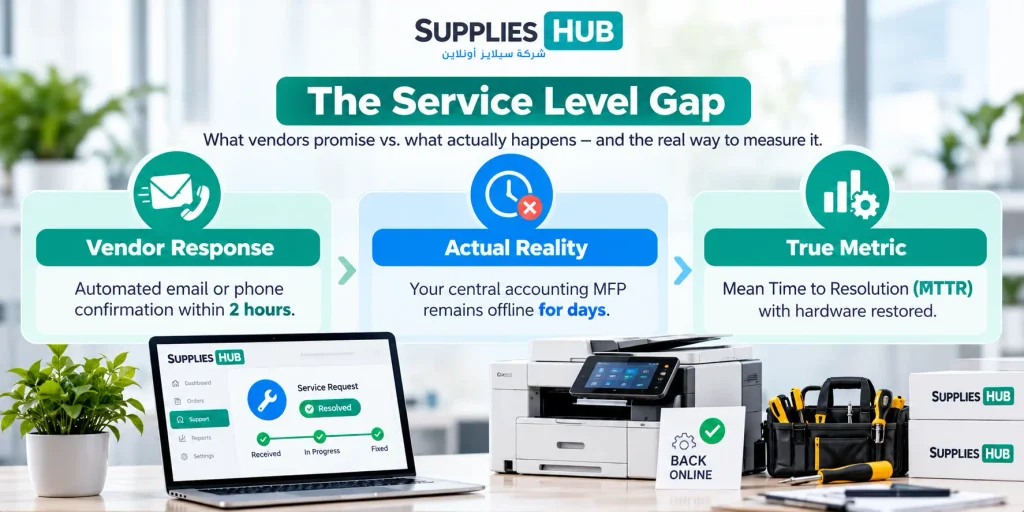
Standard vendor agreements often boast a “Two-Hour Response Time.” In reality, this metric is routinely satisfied by an automated email confirmation or a call from a tier-one dispatcher asking for the printer’s serial number. Meanwhile, your production floor or administrative office remains completely halted.
Your contract must define Mean Time to Resolution (MTTR) and specify on-site physical arrival. A defensible agreement categorizes incidents by operational severity:
Expert Takeaway: Never sign a contract that lists only a generic “response” window. Insist on explicit phrasing: “On-site arrival of a qualified technician equipped with diagnostic tools and standard replacement parts within X hours of ticket logging.”
Vendors frequently market contracts as “all-inclusive,” leading procurement teams to assume every breakdown, spare part, and consumable item is fully covered. In practice, the fine print often carves out the most expensive maintenance items.
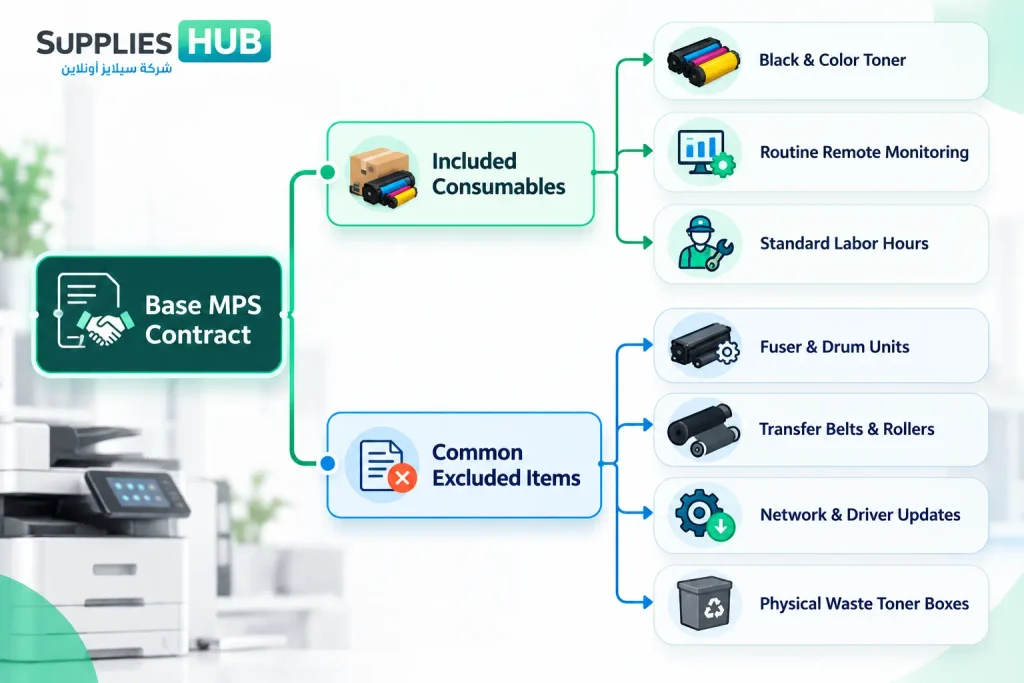
Verify whether the following items are bundled into your cost-per-page (CPP) or billed separately as ad-hoc repair parts:
When an operating system update disrupts network printing across your organization, does your vendor resolve the driver deployment, or do they classify it as out-of-scope IT consulting? Ensure that universal print driver management, network configuration, and firmware security updates are explicitly named as standard maintenance duties.
For organizations managing existing, client-owned hardware fleets that do not require full machine replacement, structuring a dedicated copier and printer maintenance contract establishes guaranteed uptime and parts coverage without requiring new hardware capital expenditure.
The billing model is where most organizations lose control of their print budget. MPS providers typically offer lower per-page rates in exchange for a guaranteed minimum monthly volume commitment.
If your business commits to 40,000 monochrome pages and 10,000 color pages per month, you are billed for that volume regardless of actual consumption. During holiday periods, Ramadan working hours, or remote work rotations, your print volume might drop by 40%, yet you still pay the full baseline fee.
Page costs are universally quoted using the ISO/IEC 19752 standard, which assumes toner covers exactly 5% of the page area.
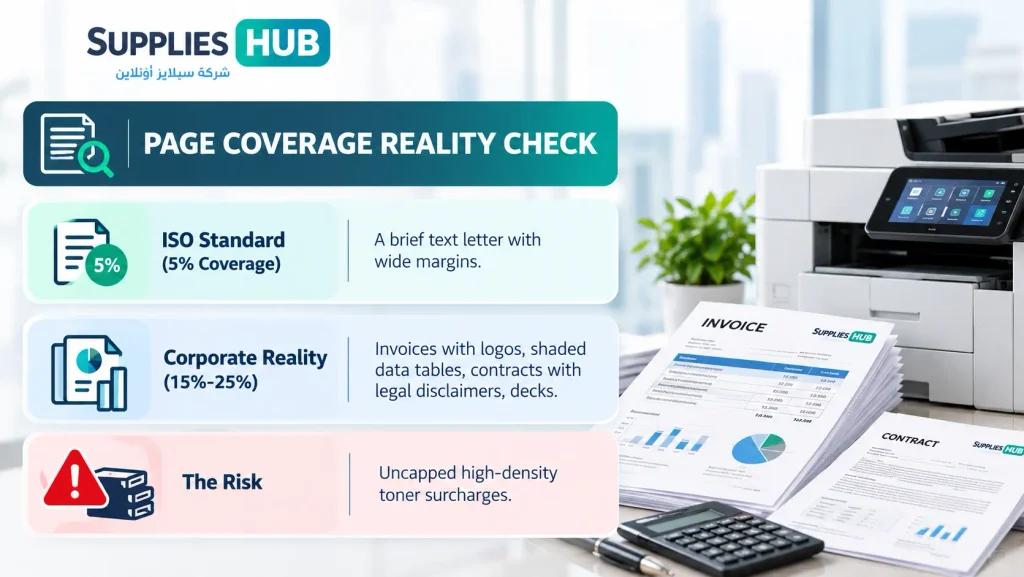
If your contract contains an unmonitored “toner density adjustment clause,” your vendor can retroactively adjust your billing or invoice you for excess toner usage when your staff prints documents with high-density graphics or legal footers.
To understand how individual component costs compound across multi-branch office fleets, review our detailed breakdown on calculating print fleet ROI and total cost of ownership.
A major hardware failure can disable a high-volume workgroup machine for days if replacement mainboards, laser scanner units, or power supplies must be imported or sourced from regional hubs. Without an enforceable loan unit clause, your operations remain paralyzed while waiting on parts.

Contracts often state: “A temporary loan unit will be provided subject to availability.” This vague language allows vendors to replace an enterprise A3 color MFP capable of 50 pages per minute with an entry-level desktop printer lacking essential features.
Demand strict specifications in your loaner clause:
An SLA without financial consequences is merely an expression of good intent. To hold your service provider accountable over a multi-year term, your agreement must include a clear escalation tree and automated service credits.
Your contract documentation should clearly list contact names, operational roles, direct phone lines, and response escalation windows:
When an SLA metric is breached, manual disputes waste administrative time. Insist on automated invoice credits tied directly to recorded downtime:
| Performance Failure | Threshold Trigger | Automatic Financial Remedy |
| Late On-Site Arrival | > 2 hours past agreed SLA window | 5% credit of the affected machine’s monthly service fee |
| Prolonged Outage | Machine down > 24 hours without an active loaner | 15% credit of the total monthly invoice |
| Missed PM Schedule | Failure to perform scheduled preventive maintenance | 10% credit of that quarter’s maintenance charges |
| Repeat Failure (“Lemon”) | ≥\ge≥ 3 identical hardware breakdowns in 45 days | Immediate permanent replacement with a new machine |
The “Lemon Clause” protects your business against manufacturing defects. If a specific printer suffers repeated breakdowns despite component replacements, the vendor must exchange it for a new, identical or higher-specification model at zero expense to you.
Modern enterprise multifunction printers are high-powered network computers equipped with internal solid-state drives (SSDs) or hard disk drives (HDDs). Every document printed, scanned, photocopied, or emailed passes through internal memory buffers and is frequently stored on the drive.
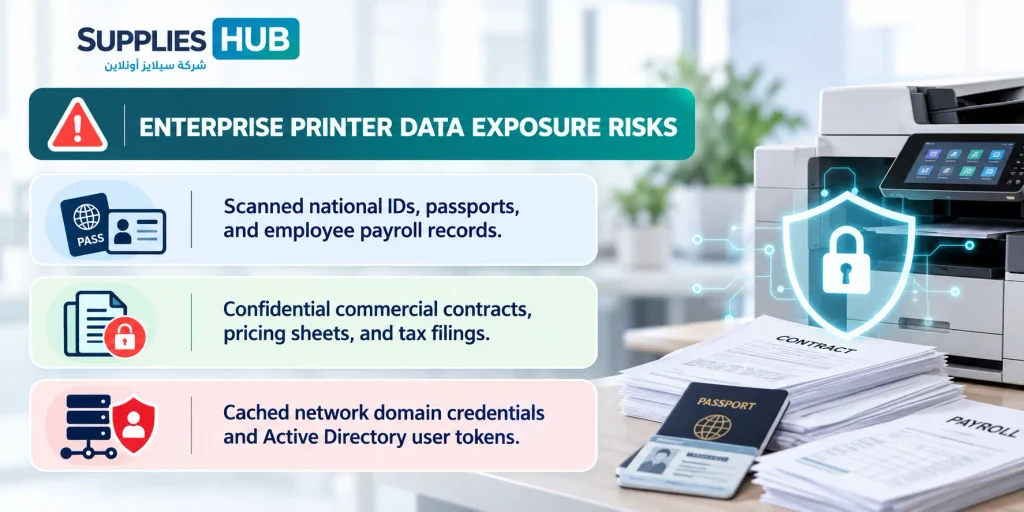
Under the Kingdom of Saudi Arabia’s Personal Data Protection Law (PDPL) and the cybersecurity controls issued by the National Cybersecurity Authority (NCA), corporate entities are legally responsible for safeguarding personal and financial data against unauthorized access or exposure. Returning an MFP to a leasing company without certified sanitization exposes your business to regulatory fines and severe data liability.
The final phase of contract negotiation governs how you exit the agreement. Unfavorable termination clauses can bind your business to an underperforming vendor long after service quality deteriorates.
Standard commercial vendor terms often include automatic renewal clauses: “This agreement shall automatically renew for successive 12-month periods unless written notice is received 90 to 120 days prior to expiration.”
If you miss this narrow notification window, you remain locked in for an entire year. Replace this clause with an obligation for the vendor to notify you in writing 60 days before contract expiry, transitioning to a month-to-month agreement if no active extension is signed.
Ensure your legal team includes a clean exit path for persistent service failures:
Who pays to remove heavy office equipment at the end of a contract? If the agreement remains silent on logistics, the provider may present substantial invoices for de-rigging, specialized transportation, and warehouse restocking fees. State clearly in writing that all de-installation, packing, insurance, and return shipping costs are either capped or included in the initial agreement terms.
Use this actionable matrix to audit vendor proposals and identify red flags before signing:
| Contract Component | Common Vendor Default (Red Flag) | Recommended Enterprise Term (Green Flag) |
| Response Metric | “Response within 2–4 hours” (via automated email/call). | “Qualified field technician on-site within 2–4 hours; MTTR ≤\le≤ 8 hours.” |
| Consumable Coverage | Toner included based strictly on standard 5% ISO yield. | All-inclusive toner supply with no high-density penalty surcharges. |
| Wear Parts & Rollers | Drums and rollers billed separately as periodic wear items. | 100% parts and labor included (drums, fusers, belts, feed rollers). |
| Volume Model | Strict device-level monthly quota; unused pages lost. | Pooled fleet aggregation with quarterly true-up rollover allowances. |
| Prolonged Outage | “Best effort” part sourcing; no replacement loaner unit. | Equivalent loan unit deployed and configured within 24 hours. |
| Failure Accountability | Informal management escalation; no financial penalty. | Automated invoice credits (5%–20%) tied directly to SLA breaches. |
| Data Protection | Vendor reclaims hardware drive without certified wipe. | Certified NIST 800-88 cryptographic wipe or client drive retention. |
| Contract Renewal | Automatic 12-month extension with 90-day advance notice. | Expiry notification required; automatic transition to month-to-month. |
| Exit Logistics | Uncapped de-installation, freight, and restocking fees. | Return logistics and pickup fees clearly capped or fully included. |
A well-structured Managed Print Services contract delivers predictable budgeting, automated supplies fulfillment, reliable equipment availability, and tight data governance. Securing these benefits requires setting clear expectations on paper before delivery trucks arrive.
By insisting on clear resolution times, pooled page volumes, comprehensive consumable coverage, and firm data sanitization protocols, you protect your organization from unexpected overhead and service headaches.
If you are currently reviewing vendor proposals or preparing an enterprise print tender in Saudi Arabia, our specialists at Supplies Hub can help. We provide transparent, SLA-backed managed office print solutions tailored to the operational demands of businesses across Riyadh, Jeddah, and the Eastern Province. Reach out to audit your current print fleet agreements and build a reliable, cost-controlled document infrastructure.

Quick Summary: Learning how to choose a paper shredder for a Saudi office depends on four measurable specifications: DIN 66399 security level, sheet pass capacity, motor duty cycle,
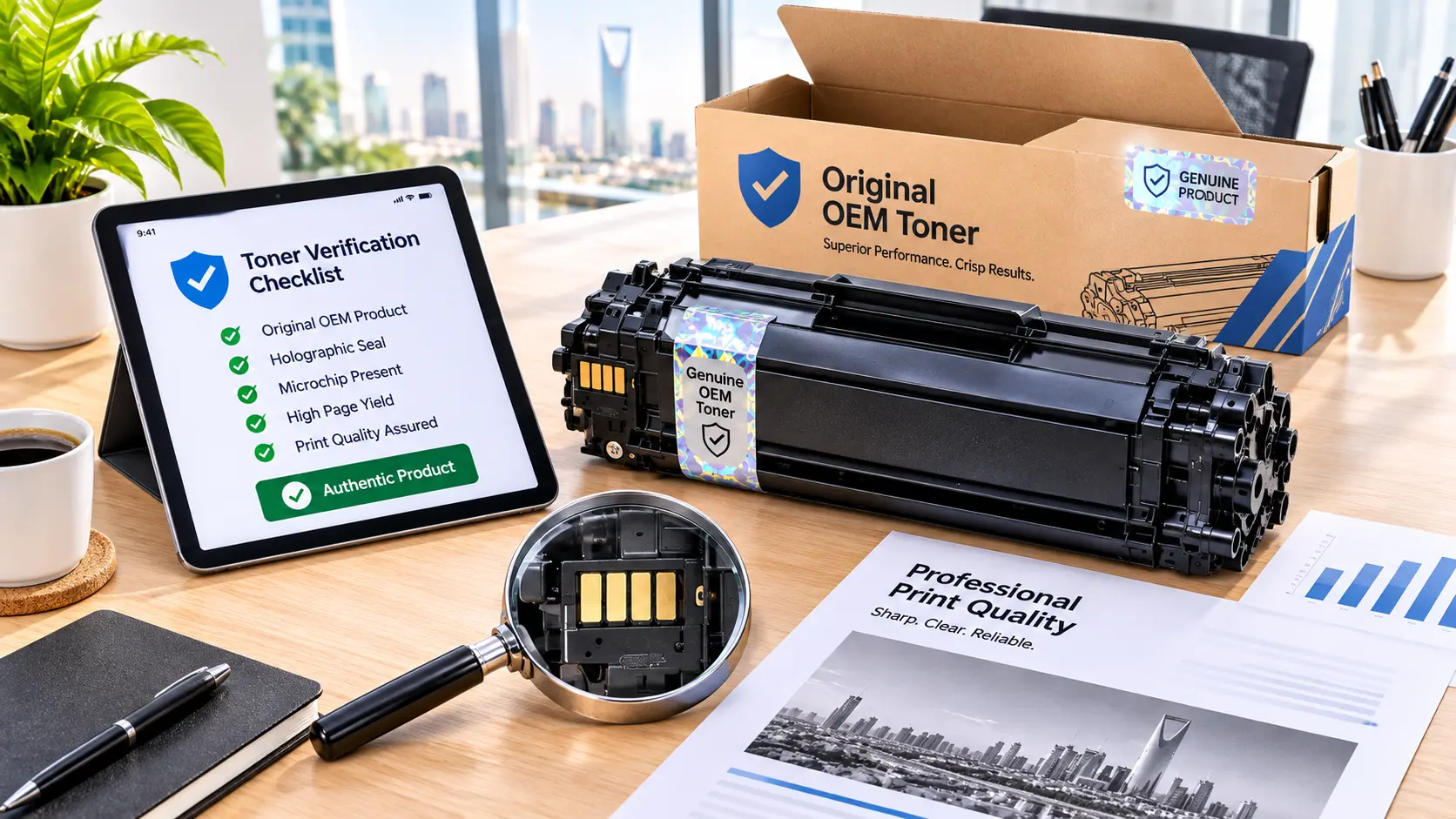
Quick Summary: Comparing original vs compatible toner comes down to four measurable factors: verifiable supply origin, serialized batch traceability, standardized ISO/IEC page yield, and clear hardware support terms.
Quick Summary: Choosing between 70 vs 80 gsm paper depends on document readability, printer feed limits, and double sided ink coverage rather than assuming heavier paper solves every